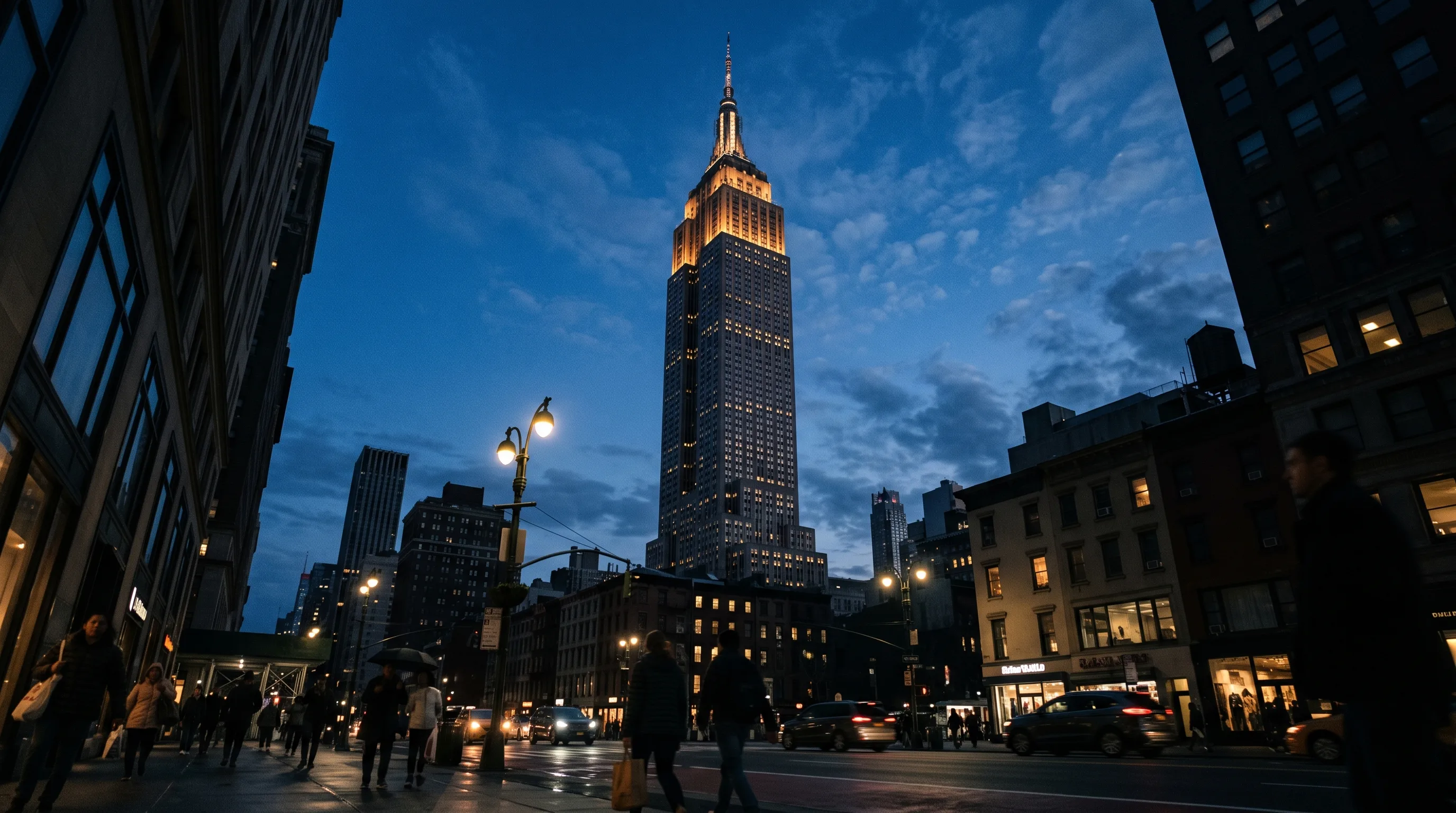
Today the Empire State Building changes colour by software: the system installed in 2012 can display “more than 16 million colors,” in the building operator’s own words. Before that, it was manual labour. The LEDs were replacing “the current palette of 10 colors, which also requires a team several hours to change the building’s nearly 400 fixtures,” as Philips put it when the project was announced. The lesson isn’t in the 16 million colours. It’s in the hours spent on the roof.
Before 2012, colour changed by hand
The tower lights have illuminated the building since 1976. For decades, what you saw from the street came from high-pressure sodium vapour floodlights making up the tower’s “halo,” plus rows of HID floodlights installed on rooftop setbacks.
Changing the colour of all that was not a desk job. The manufacturer describes the procedure plainly: “For each color change, this team would spend hours manually installing color disks on each luminaire — a costly, high-maintenance procedure.”
Colour already existed, in other words. What cost money was getting to it.
What the 2012 system actually solved
The building and Philips jointly developed “a state-of-the-art dynamic lighting system from Philips Color Kinetics.” The new computerized system, per the announcement, allows “customized light capabilities from a palette of over 16 million colors, including hard-to-achieve pastels, in virtually limitless combinations.”
Three details matter more than the colour count:
- The system is Ethernet-based, and lets operators adjust “each individual luminaire or lighting zone.”
- An astronomical clock “can trigger light shows and scenes on certain dates or times of day, enabling the building’s lighting timetable to be set months in advance.”
- The new solution was “predicted to consume approximately 73% less energy than the previous system.”
The work took “more than six months of installation,” and the result debuted on November 26, 2012.
The real lesson: colour is an access problem
A homeowner deciding between a warm-white system and a colour system is almost always asking the wrong question. They compare colours. The Empire State Building shows that the real variable is access to the fixture.
As long as colour depends on someone physically reaching every luminaire, it stays rare, expensive and reserved for big occasions. The moment colour lives in the controller, it becomes an ordinary evening decision — no ladder, no crew, no intervention.
That is exactly the same switch on a house. The difference between “I can change that” and “someone would have to go back up” is settled on installation day, not afterward.
What that means on a Québec roofline
On a house, the roof is the equivalent of the Empire State Building’s rooftop setbacks: somewhere you don’t return to often, and never in January. The consequence is simple — what isn’t installed at the start isn’t easily added later.
That’s why the hardware is specified to stay put: LEDs rated IP68, tested to −40 °C, with a rated lifespan of 50,000 hours and up. And it’s why the warranty is split by what lives where: 12 years on controllers and pixels, 3 years on light bars and landscape fixtures, with labour covered for 3 years.
So the “colour or not” decision belongs before the install, during the visit. That visit is free and takes about 40 minutes: we walk the property with you, talk through what you want lit every night, show you a demo, present the whole-project quote line by line, then measure. The rest — what’s covered, what needs maintenance — lives on our FAQ page.
If a programmed schedule interests you more than a colour wheel does, that’s already the principle behind our exterior lighting: a default scene, with colour saved for the few evenings it actually earns its place — including the ones covered by holiday lighting.
Common questions
Does the Empire State Building still change colours manually?
No. Since the 2012 installation, changes are made through the computerized system rather than by installing colour disks on each fixture.
Are 16 million colours useful on a house?
The number itself isn’t the value. What changes a homeowner’s experience is being able to program a scene and a schedule without touching the hardware. The palette is a by-product, not the goal.
Can colour be added later to a white-only system?
This is exactly the access problem described above: anything involving hardware mounted at height means going back up there. The question is far cheaper to settle at design time.
Does LED lighting really use less energy?
In the Empire State Building’s case, the new system was announced as consuming approximately 73% less energy than the one it replaced. That figure belongs to that project and the equipment it replaced — it isn’t a general rule.