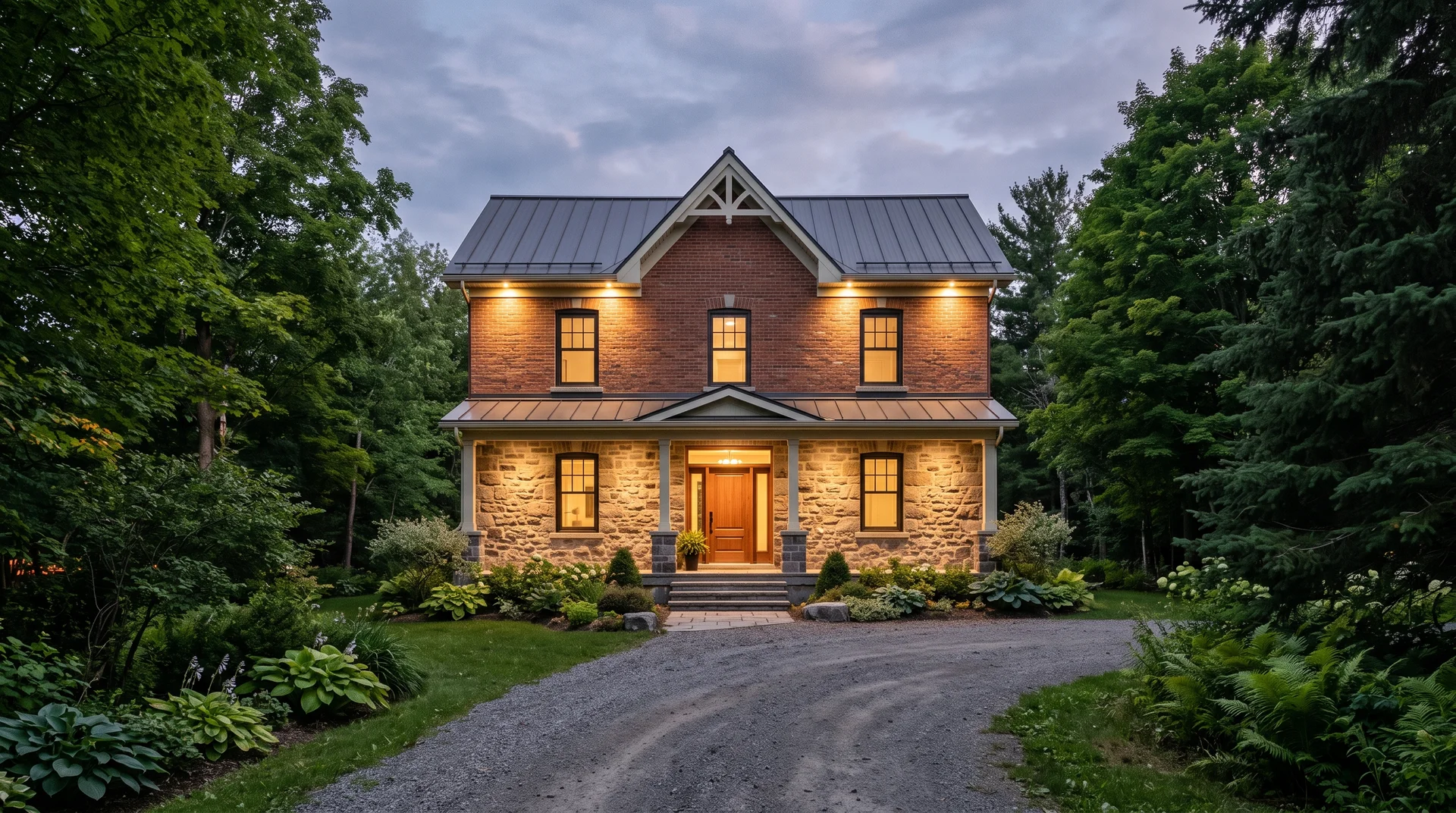
To plan permanent lighting during a renovation, start by defining the result you want and the parts of the house that will change. We then recommend discussing those choices with the people responsible for the work before settling the lighting project’s details.
You do not need to choose every fixture immediately. Start with a shared description of the result: a welcoming entrance, an accentuated facade or a garden where you would like to spend the evening. Equipment belongs in that conversation, alongside the realities of your house.
This is our recommended preparation method. It is not a construction plan or a fixed sequence for the different trades.
Describe the house after the work
A current photograph is useful. If cladding, soffits or landscaping will change, bring something describing the intended result too: a drawing, a material selection or a clear note about what remains undecided.
We suggest dividing your preparation into three columns.
- Staying: the elements you do not plan to change.
- Chosen: changes whose final appearance is already defined.
- To confirm: details that still depend on a decision or another person.
For example, “cladding chosen, soffit detail to confirm” is more specific than “redo the facade.” That is an example of wording, not an account of a completed project.
The distinction belongs in the discussion. Our visit process considers, among other details, the difference between a boxed soffit and an open eave, which take different rails. A photograph from before the renovation may not describe the detail you want assessed.
Give each viewpoint a priority
Look at the property from the street, but also from the door, a window and wherever you sit in the evening. We suggest noting what you want to highlight from each viewpoint instead of starting with a fixture count.
You can choose one main priority and a few secondary intentions. “I want to see the entrance clearly, then define that volume” gives the conversation a direction. “I want everything lit” leaves more decisions open.
Our preference is to treat the facade and grounds as connected subjects without assuming they need the same treatment. Our exterior lighting and landscape lighting pages can help you prepare questions.
Prepare a conversation between the people doing the work
If several people are involved in the renovation, identify a point of contact and gather the questions affecting more than one part of the work. Who confirms the final soffit detail? Who approves a finish change? Which dates are firm, and which are still provisional?
We recommend writing down the agreed answers, including the questions that remain open. The aim is to make dependencies visible, not to ask you to manage a technical detail yourself.
Do not treat this article as an installation instruction. It does not tell you to run a cable before cladding or close a surface by a particular date. The actual sequence needs to be discussed for your project with the people responsible for it.
Use the visit to compare intentions
The Vision Bleu visit is free and takes approximately 40 minutes. We walk the property with you, discuss what you want lit each evening and show a demonstration. We present the whole-project quote and explain it line by line, then measure rooflines, levels and soffits.
The estimate deliverables—visit, measurements, photos and 3D rendering—are free. Bring renovation documents if you have them: that is our preparation advice, not a condition of booking. We are not promising that a rendering is produced instantly during the visit.
To compare two intentions, ask a concrete question: “What do we want to see from this window?” or “Is this area still part of the project after the finish changes?” That is more useful to our design discussion than selecting equipment without reference to the intended result.
Separate design, commitment and warranties
The visit is free to book. If you sign the residential agreement on the spot, a 30% deposit applies at signing; the balance is due on completion. A free estimate does not mean there can never be a deposit, regardless of what you decide during the visit.
Coverage also depends on the item: 12 years for controllers and pixels, 3 years for light bars and landscape fixtures, and 3 years for labour. That is not a uniform 12-year warranty on every aspect of the installation.
We recommend keeping the accepted quote together with the renovation coordination decisions, then asking for clarification if the scope changes. Our FAQ is a starting point for other preparation questions.
Common questions
Should I wait until the renovation is finished to discuss lighting?
We recommend discussing it during planning, even if some choices remain open. That does not set an installation date: the sequence still needs to be agreed for the project.
Do I need complete plans before the visit?
We recommend bringing what you have: photographs, finish selections and questions. They are discussion aids, not a booking requirement introduced by this article.
Do I pay for the visit if I do not sign?
The visit and estimate deliverables described here are free. If you sign the residential agreement on the spot, the 30% deposit applies at signing.
Does this article tell me when to run the wiring?
No. It proposes a preparation and coordination method. It gives neither electrical instructions nor an installation sequence intended for every site.