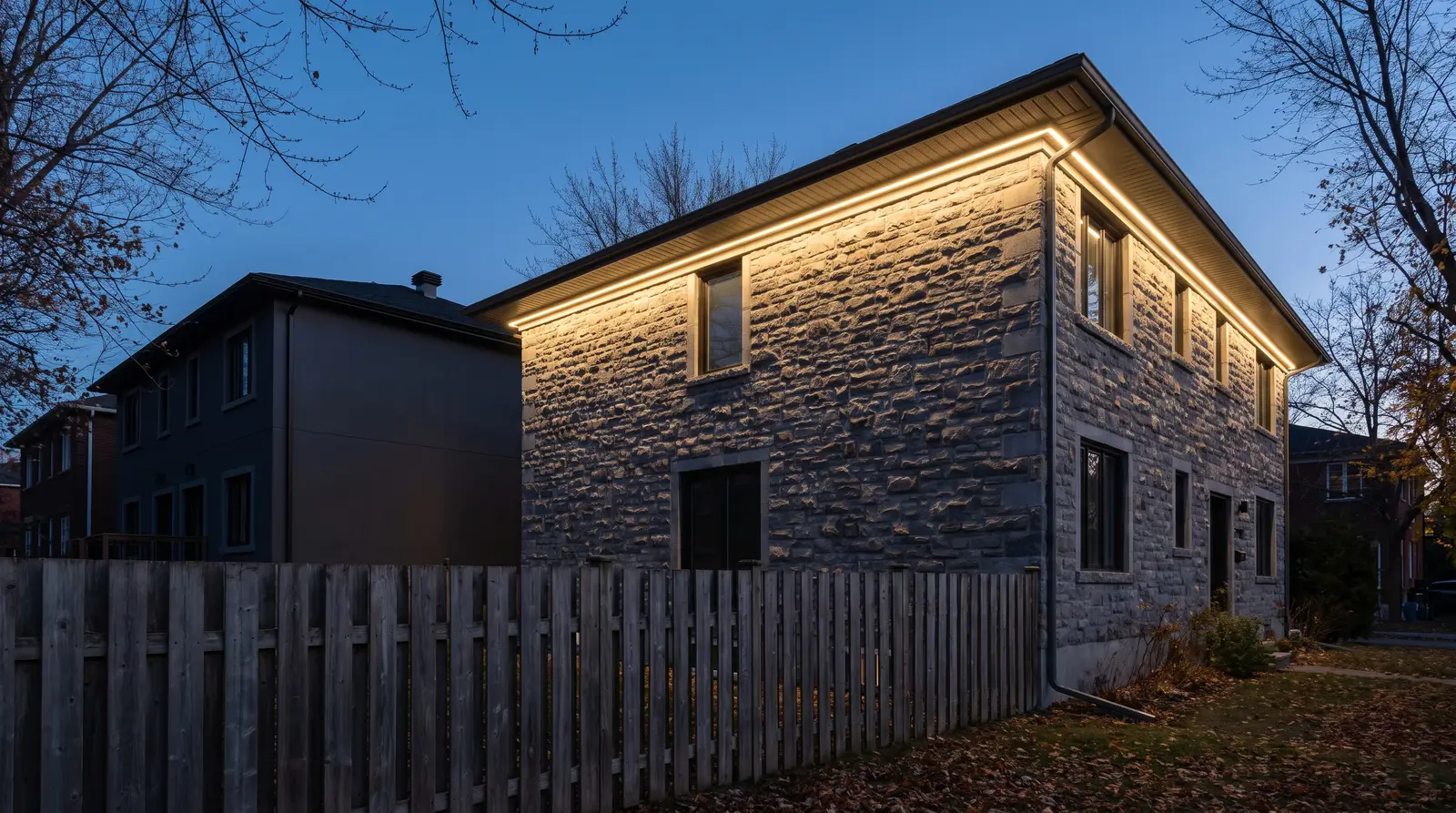
There is no single Québec law governing residential outdoor lighting. Municipalities regulate it, and two requirements recur from one bylaw to the next: light must be aimed at the ground, and nothing should spill onto a neighbouring property. A cap on the colour of the source, in kelvins, is a narrower rule: it’s in the Mont-Mégantic reserve’s regulations, and in Saint-Laurent for signage. Everything else depends on your town — and in the Mont-Mégantic region the rules are considerably stricter than elsewhere.
This is not legal advice. It’s a plain read of public texts, and your own municipality remains the only valid source for your address.
Quick reference
- No single provincial rule for lighting a house’s exterior.
- The power is municipal, through nuisance bylaws or zoning.
- The most universal requirement: the light flux goes downward.
- Colour temperature, in kelvins: capped in the Mont-Mégantic reserve, and in Saint-Laurent for signage.
- The strictest rules we found: the Mont-Mégantic International Dark Sky Reserve.
- What to check: your own municipal bylaw, before installing.
Where does the power to regulate come from?
From the municipal level. The Québec government’s urban planning guide states that a municipality may adopt nuisance bylaws under the Loi sur les compétences municipales (articles 59 to 61) and the Loi sur l’aménagement et l’urbanisme (article 113).
The same guide names lighting as an explicit example: a nuisance bylaw may include provisions countering the negative effects of excessive exterior lighting, in particular light directed toward the sky.
That’s why there’s no one answer. Two houses fifteen kilometres apart can fall under two different bylaws.
The rule that recurs everywhere: light points down
On the island of Montréal, the Saint-Laurent borough adopted light pollution rules with four stated requirements, one of them to direct light flux toward the ground. The same regulation caps signage light sources at 4000 K and requires advertising panels to reduce their intensity between 11 p.m. and 6 a.m.
Two details are worth noting. Temporary exterior lighting for special events is excluded from the regulation’s scope. And the regulation is aimed first at signage and non-residential uses — it’s the downward-orientation principle that carries across other bylaws, not necessarily the 4000 K figure applied to a house.
The strictest rules we found: Mont-Mégantic
The Mont-Mégantic International Dark Sky Reserve publishes concrete rules that are enforced through bylaws in the municipalities on its territory. Its regulations summary requires light sources of 2200 K and less for all exterior uses; a 3000 K ceiling exists only for named uses, and for a source under 1,000 lumens only in the Haut-Saint-François and Granit RCMs. The fixture also has to be aimed at the ground — the regulation allows less than 1% of the luminous flux above the horizon. For a household fixture above 1,000 lumens, the reserve’s homeowner guidance points to an amber LED between 1800 K and 2200 K.
White LED is prohibited for exterior use there, except for a few specific uses named in the bylaws.
If you live on that territory, a coloured facade for Halloween may simply not be permitted. That’s the kind of thing we’d rather tell you before the quote than after the install.
What this changes for a house
A rail mounted under the soffit throws its light downward onto the facade by construction. That is exactly the geometry most bylaws ask for — and it’s why it is far easier to keep the light on your own lot.
Landscape lighting is the trickier half. A ground-mounted fixture uplighting a tree necessarily sends part of its output upward, and that’s where aiming and shielding matter. We account for it at the design step, both on the landscape lighting page and on the ground.
For holiday lighting, several municipalities allow seasonal or temporary exceptions — but not all of them, and not in the same way. Read your own town’s text.
How to check your town, in three steps
Look up your municipality’s zoning bylaw and nuisance bylaw on its website. The useful search terms in French are “éclairage extérieur”, “pollution lumineuse” and “nuisance”.
Then call the urban planning department and ask a specific question rather than a general one: is a fixed luminaire installed under the soffit, aimed at the ground, permitted at my address?
Finally, keep the answer in writing. An email confirmation from the planning department is worth more than a phone conversation.
The municipalities we work in are listed on the service area page, and product definitions live in the FAQ.
Common questions
Do I need a permit to install permanent lighting on a house? It depends on the municipality. Some require one under the zoning bylaw, others don’t. Ask your town’s planning department before work starts.
Can a neighbour complain about my lighting? Yes, and it usually goes through the nuisance bylaw. A fixture aimed at the ground, whose light doesn’t cross the property line, resolves most of these situations at the source.
Are Christmas lights covered by these bylaws? Often not, or only partly: several bylaws exclude decorative holiday lighting between November 15 and January 15, along with temporary lighting tied to special events. Two of the three bylaws we read key on the season alone; a third also says temporary, which a permanent system plainly is not. Whether yours qualifies is a question for your town.
Does Montréal have one bylaw for the whole city? No. Boroughs have their own, and Saint-Laurent is the one that moved earliest on light pollution.
Does this replace legal advice? No. It’s a read of the public texts cited above. Your municipality remains the only valid source for your address.