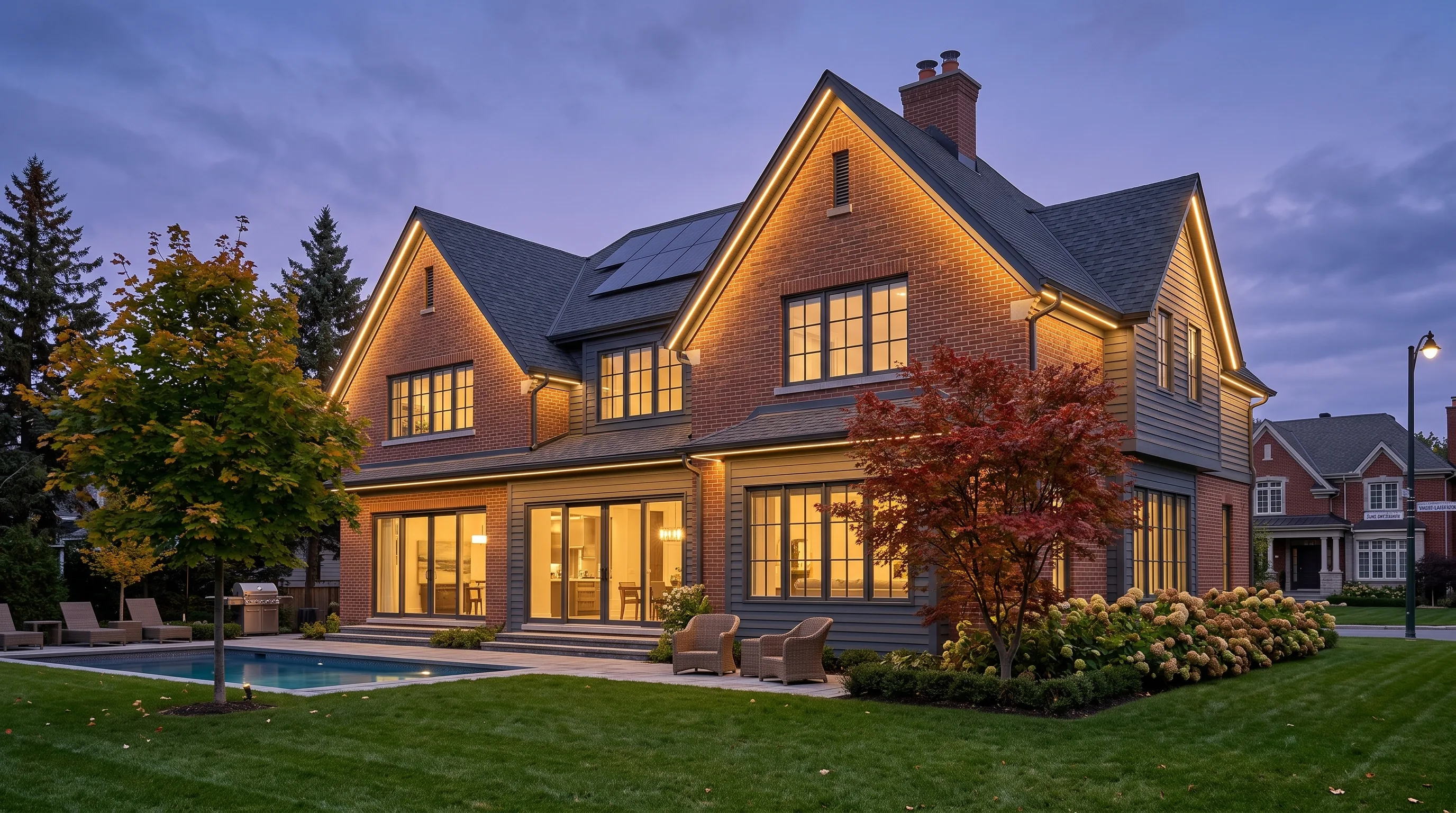
A permanent exterior lighting project on a Greater Montréal home runs about $3,000 to $5,000 for a starter project, about $5,000 to $15,000 for a standard one, and $20,000 and up — often above $50,000 — for a house lit end to end, exterior, interior and backyard. Those are whole-project prices, not per-foot rates. Where you land in that range comes down to roofline length, how many storeys, how many roof peaks, and how easily a crew can reach the work.
Quick reference
- Starter project — about $3,000 to $5,000. One front roofline, one or two storeys, straightforward access.
- Standard project — about $5,000 to $15,000. More elevations, more peaks, usually the back of the house too.
- Complete project — $20,000+. The full envelope, several zones, often landscape lighting with it — on a home lit end to end, the bill often exceeds $50,000.
- What moves the number — length, storeys, peaks, access, and how many zones you want.
- What doesn’t move — the warranty. 12 years on controllers and pixels, 3 years on light bars and landscape.
Why is the range that wide?
Because a single-storey home with one straight roofline and a two-storey house with three peaks and a rear addition are not the same job. The hardware is similar. The time, the access and the metres of rail are not.
That is also why we don’t publish a per-foot price. A per-foot number looks precise and is usually wrong, because length is only one of the things that separate two houses.
What actually changes the price?
Roofline length
This is the obvious starting point. We measure every soffit level we light — not only the top one. The first storey and the covered entry count too, because a facade lit only at the roof reads as cut in half after dark.
Storeys and access
A second storey changes install time more than length does. A house tight to the lot line, a mature hedge, a slope to the back, a narrow driveway — each one decides whether the crew works from a ladder or a lift, and that shows up in the price.
Roof peaks
A peak is the triangle at the end of a pitched roof, outlined edge to edge. Peaks add cuts, not just metres, and a three-peak house takes more work than a longer but perfectly straight one.
How many zones
A zone is a section you can switch, schedule or colour on its own. One front zone costs less than the facade, the columns, the entry and the backyard all running independently — that’s a comfort decision, not a technical limit.
Is the warranty part of the price?
Yes, and there are two of them. Controllers and pixels carry 12 years. Light bars and landscape lighting carry 3.
Labour is a separate three-year warranty. Inside those three years, a service call to replace a covered part costs you nothing. After that, the part stays covered on the schedule above, but the visit is billed hourly at the rate in force at the time.
That split is worth asking any contractor about before you sign. The Régie du bâtiment du Québec lists the nature and duration of the parts-and-labour warranty as one of the things a complete written estimate should contain, alongside the licence number of the contractor and, where applicable, of any subcontractor.
What doesn’t change it
Warranty terms don’t move with the size of the project. The schedule above is the same one whether the job is a single front roofline or the whole property.
That matters when comparing quotes. If one price is far below the others, ask what the rail is, what it is rated for, and how long the parts and the labour are covered.
Can the cost be spread out?
0% financing is real for qualifying projects, through an outside partner. Approval depends on your credit, so treat it as available rather than automatic — nobody can promise it before the application goes in.
When it isn’t worth the money
If you’re moving in two years, the math doesn’t work. Permanent lighting spreads its cost over ten or fifteen years of use, not two seasons, and it does not come off the house and follow you to the next address.
Same answer if what you actually want is three weeks of red and green in December and nothing else. The system does that, but you’re paying for capability you won’t use — the exterior lighting page shows what a year-round install looks like instead.
Two things you only learn on site
The cladding decides more often than the length does. A flat aluminum soffit goes up quickly; a wood overhang with decorative brackets needs a cut at every bracket, and the same elevation takes longer.
The other one is where the electrical panel sits. If the controller has to live at the opposite end of the house from the available supply, a line has to be run, and that route never shows up in a photo — someone has to stand there and look at it.
One free piece of advice before you sign with anyone: check the licence in the RBQ’s public registry. A valid licence gives you access to a financial guarantee if a dispute comes up. Ours is 5864-7108-01.
How we get to your number
The visit takes about 40 minutes. We measure, we photograph, and you get a 3D rendering of your own house before anything is ordered.
That step is what turns a range into a price. You see the lit facade before you decide, and the number attached to it matches the thing you just looked at. If your town is inside the service area, the visit is free.
Landscape lighting is quoted separately and has its own variables — the landscape lighting page covers those. The services page lists all four in one place if you want to compare before calling.
Common questions
Do you quote a price per linear foot? No. The published numbers are whole-project prices, because the length of the roofline is only one of the things that set two houses apart. A per-foot rate would look precise and be wrong most of the time.
Does the price include the app and the programming? Yes. The controller, the app and the zone programming are part of the project. You set brightness, schedules and colour — 16 million of them — from the app: there is no service call to book and no charge for changing a scene.
What does it cost to run each night? That depends on how much is installed, how bright you run it and how many hours. We don’t publish a monthly figure because it would be invented for your specific house; we can estimate the proposed system’s draw during the visit.
Can I do part of the house now and the rest later? Yes, and plenty of people do. Front elevation first, backyard or landscape a season or two later — everything runs on the same controller, so adding a zone later is a wiring job, not a new system.
Does it come off if I sell? No. The rail is fastened into the building envelope and stays with the house. Finished installs are in our projects, and more questions like this one live in the FAQ.