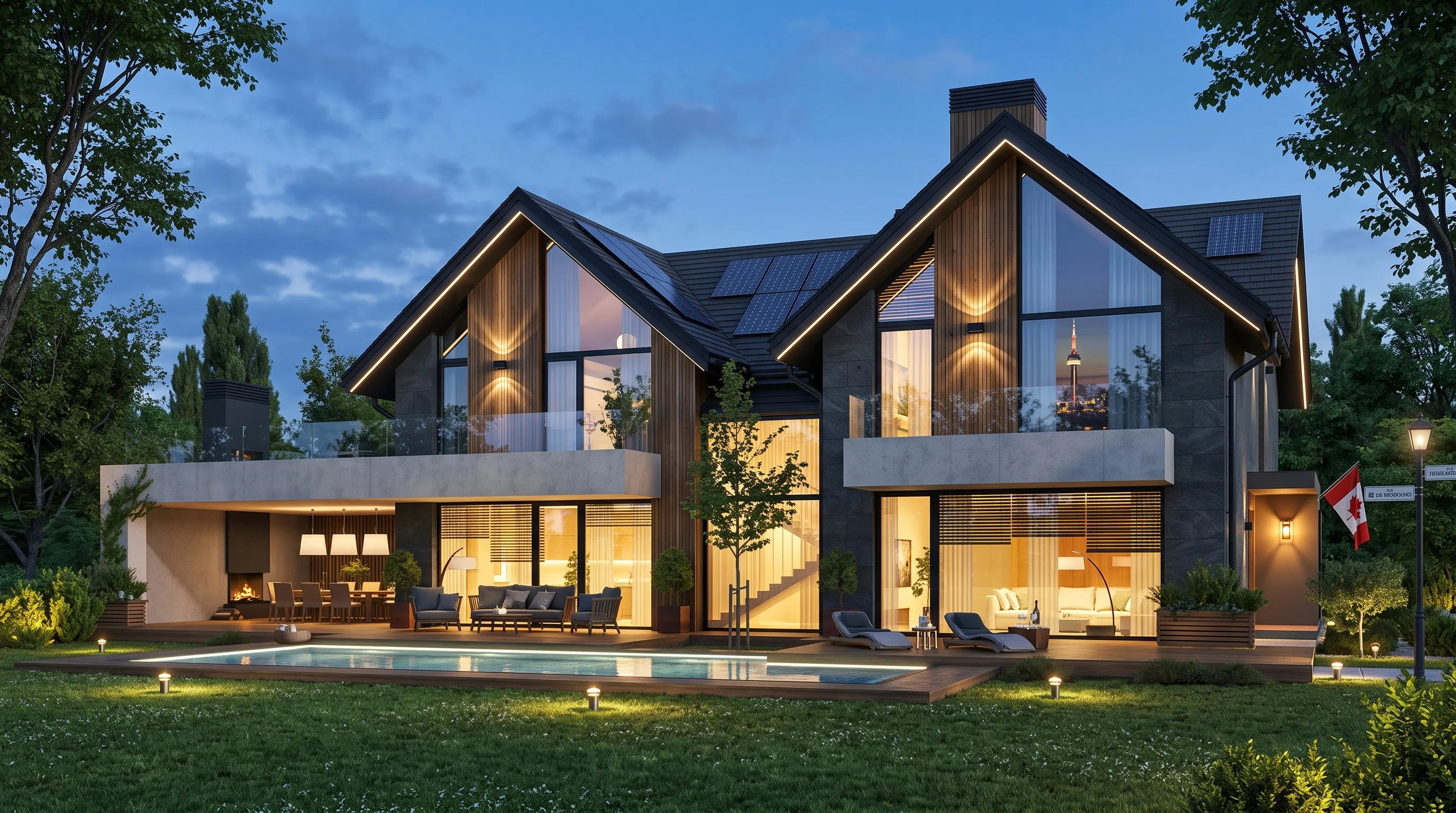
Four areas on a house take light: the roofline, the peaks, the columns and the backyard. The roofline does about half the work on its own — it is what makes the house readable from the street — and the other three decide whether the house has a shape after dark or just an outline.
Quick reference
- Roofline — the continuous run under the roof edge. The starting zone on nearly every project.
- Peaks — the triangular top at the end of a roofline, outlined edge to edge.
- Columns — the verticals: corners, cuts, entry columns. They supply the depth.
- Backyard — the back of the house, the garage side, the patio steps.
- The rail is aluminum, available in 120+ finishes, and installs with zero exposed wire.
The roofline is the zone that changes the house
This is not a few spotlights aimed at a wall. It is a continuous run fitted along the front leading edge of the roof, section by section: the slim aluminum housing sits on the outer edge of the fascia, and the light throws down and outward from that edge, which is what traces the outline of the roof. The wall below stays comparatively dark. From the sidewalk you read a line drawing the building, not a glow leaking out of a recess.
It is also the zone people misread. A ground-mounted floodlight aimed up at a wall throws light at the sky and at your neighbour’s window as well as at your siding. A run under the roof edge only ever goes down your own house, which is why it gets installed for plenty of clients who were not shopping for a decorative effect at all.
We light every soffit level, first storey and porch included. A house where only the top line is lit gives itself away immediately: the lower half stays dark and the facade reads as if it were cut in two.
Peaks give you shape, not just outline
A peak is the triangle at the end of a roofline. Run the light up both rakes to the apex and it becomes a distinct shape after dark instead of an extension of the horizontal line underneath it.
The detail that decides the result is the apex. The run has to follow both rakes and meet at the point. A rail that stops a foot short of the top is something nobody can name and everybody notices. That gets settled while the house is being measured, not afterwards.
Columns are the verticals
Corners, cuts, porch columns, the change of material where stone meets wood. Verticals give the depth the horizontal runs cannot, and the facade stops reading as a flat drawing.
An honest reservation: vertical bars on columns look right on contemporary houses with straight lines and clean volumes. On a traditional cottage with turned columns and heavy trim it is a real debate, and often we recommend against them. That conversation happens on the visit rather than as an extra zone on a quote.
The backyard is the zone people forget
The back of the house, the side of the garage, the risers on the patio steps. These are the areas that went dark the moment the sun set, and they are the ones the family actually uses — not the front the neighbours look at.
It is also the zone that pairs best with landscape lighting: the house supplies the high line, the ground fixtures pick up the trees and the beds.
Light bars or an addressable pixel rail
Depending on the project, the facade gets light bars or an addressable pixel rail. Both are sealed to IP68 — rated for immersion, not just splashes — and tested to −40°C. The difference is elsewhere: pixels address individually, and the warranty is not the same. Controllers and pixels carry 12 years. Light bars carry 3.
That is a question worth asking any installer before signing, ours included. The exterior lighting page shows all four zones in photographs, and the FAQ sets out both warranties.
Where to start
If the budget forces a choice, the roofline goes first and the peaks go second. Columns and the backyard add well later — the rail is there, the controller is there, and one more zone is not a rebuild of the system.
Common questions
Do I have to light all four zones? No. Plenty of projects stop at the roofline and the peaks, and the house is already a different house at night. The rest are additions, not prerequisites.
Does installation damage the roof or the siding? No. The rail fastens under the roof edge, into the soffit or the trim — never through the shingles — and the wiring runs through cavities that already exist.
How long does the install take? Standard installations run one to three days. Large properties, three-storey homes and projects combining several zones can take over five.
My house has no peaks. Is that a problem? Not at all. A flat or low-slope roof reads well on the roofline alone, and the verticals matter more on that kind of house. You can see both in our project photos.
Do you cover my town? We are based in LaSalle and work across Greater Montréal and well beyond it; the service area page checks a postal code, or call (450) 999-7258.