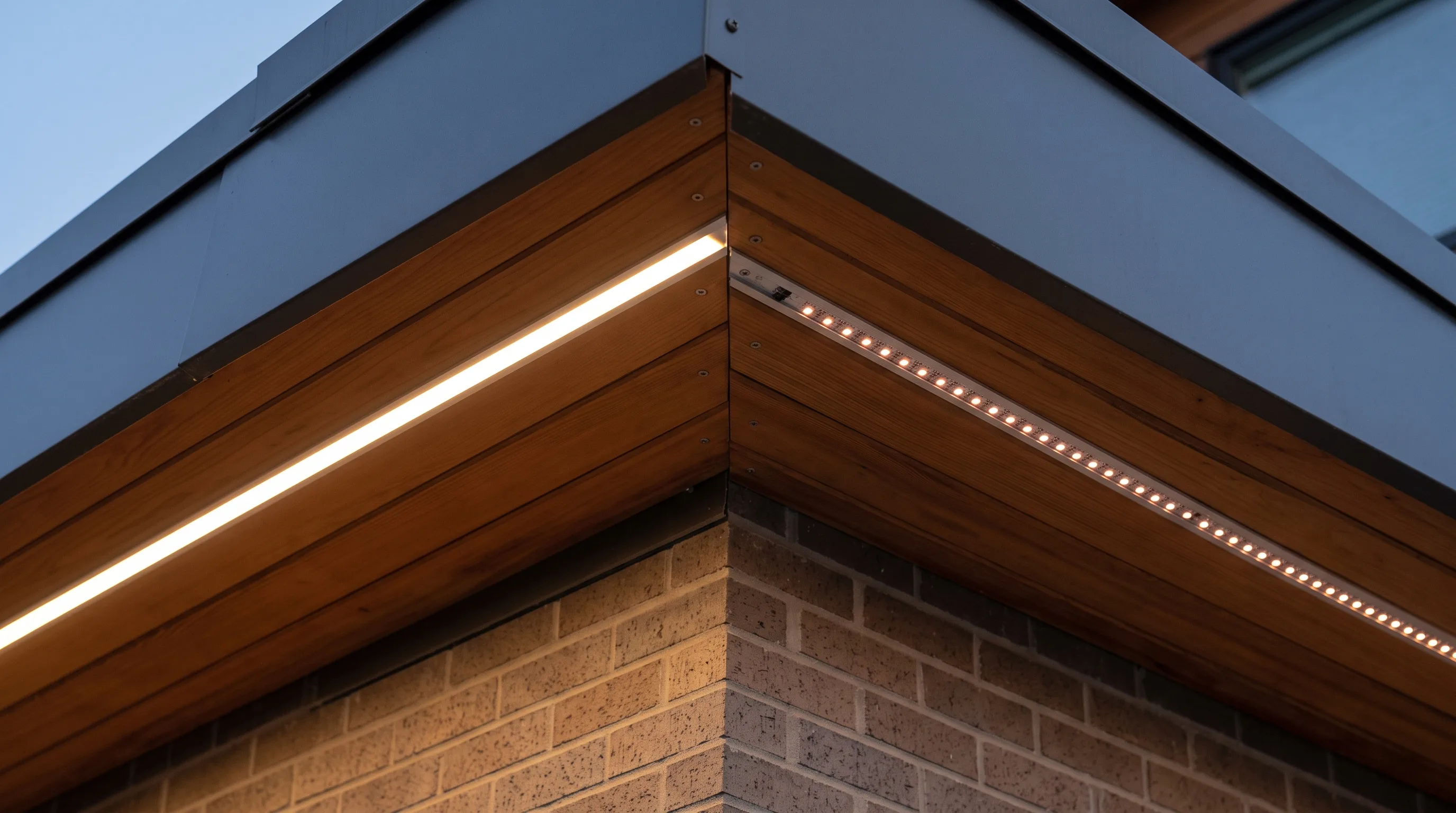
It depends on the facade, and both answers are normal: plenty of homes get light bars only, some get an addressable pixel rail, and many projects use both on different sections. What you see is the first difference — one unbroken line of light versus individually controllable points of colour. What you sign is the second: three years of product warranty on light bars against twelve on pixels and controllers.
Quick reference
| Light bars | Pixels | |
|---|---|---|
| What you see | One continuous line, no visible dots (COB) | Individual points inside an aluminum rail |
| Colour | Warm white through cool white | RGBW, colour per point |
| Control | Dimmable 1–100% per zone | Scenes, colours and animations per zone |
| Product warranty | 3 years | 12 years (pixels and controllers) |
| Labour | Separate 3-year warranty | Separate 3-year warranty |
What a light bar is
A light bar uses a COB source: the LEDs sit so close together, behind a diffuser, that there are no visible dots at all. What you see is a clean unbroken line of light following the soffit edge.
It runs warm white through cool white and dims 1–100% per zone. That covers the two modes you will use most — warm white in the evening, a cooler white for overnight security.
What it does not do is a colour scene. No red on one point and green on the next, no animation running along the line.
What a pixel rail is
A pixel rail holds individually addressable RGBW points inside an aluminum profile. Each point can show its own colour, which is what makes scenes possible: alternating colours, separate sections, animation.
It is also the product that carries the twelve-year warranty, along with the controllers. Read that line carefully, though: twelve years is parts coverage. Labour is a separate three-year warranty. After those three years the covered parts stay covered, but the visit and the time are billed hourly at the rate in force then.
Up close, a pixel rail reads as a row of points. The farther back you stand, the tighter those points sit together and the less the run reads as separate dots. That is why how far your house sits back from the sidewalk becomes part of the on-site conversation.
How the call gets made on your facade
This is settled during the visit, not at signing. Three things carry most of the weight.
First: do you want colour scenes, or just a good white line? If the honest answer is “white, always”, light bars do the job and the question is closed.
Second: geometry. Some sections — a long straight roofline, a porch underside — give a flawless continuous line. Others, like peaks seen from the street, are exactly where a colour scene registers.
Third: the project budget as a whole. On a full house, pixels everywhere is not always the best use of the envelope. A mixed project — pixels on the roofline and peaks, bars on the porch and garage — often buys the better-looking result for the same money.
Mixed is common, not a compromise
People often arrive assuming they have to pick a side. You do not. A facade can carry a pixel rail on the zones seen from a distance and light bars on the zones that stay white anyway.
The thing to take away: ask explicitly, zone by zone, what is being installed and which warranty applies to it. A house that is entirely light bars is a completely normal project here — but it carries three years, not twelve, and nobody should be finding that out in year four. The exterior lighting page shows both products in place, and the project gallery lets you see the difference with your own eyes.
Common questions
Can I add pixels later? That is a job-by-job answer, depending on the controller and the wiring already in place. Say so during the visit if it is a possibility — it is easier to plan for than to retrofit.
Do light bars do colour? No. They run warm white through cool white, with dimming. Colour and scenes come from pixels.
Why isn’t the warranty the same? They are different products. Controllers and pixels carry 12 years; light bars and landscape lighting carry 3.
Do both handle winter? Yes. The exterior components are sealed to IP68 and rated to operate down to −40 °C, so packed snow, freezing rain and freeze-thaw cycles are part of the spec — under a soffit, along a roofline, on a column or up a peak.
How do I find out what my facade gets? It is decided during the visit, zone by zone, and written into the estimate. The FAQ and the services page cover the rest of the process.