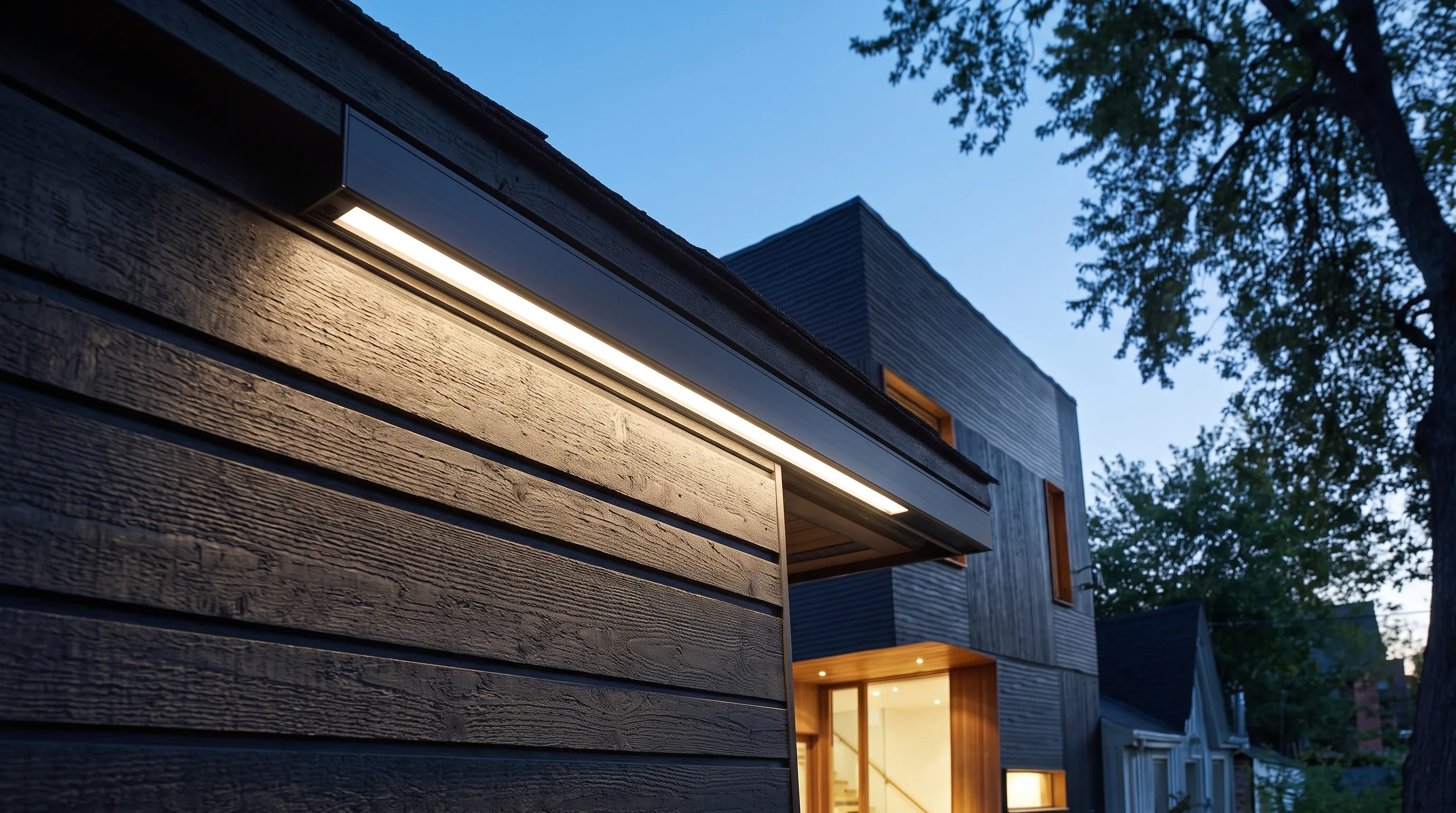
Fifteen to twenty-three years. The LEDs in a permanent system are rated past 50,000 hours, and what decides where you land in that range is how many hours a night you run them: six hours a night works out to about 23 years, nine hours a night to about 15.
That is the number to hold next to a box of string lights, which you replace, restring and re-clip every December.
Quick reference
- LED rated life: 50,000+ hours
- 6 hours a night → about 23 years
- 8 hours a night → about 17 years
- 9 hours a night → about 15 years
- Product warranty: 12 years on controllers and pixels, 3 years on light bars and landscape fixtures
- Labour warranty: 3 years
- Hardware rated IP68 and −40°C
What “50,000 hours” actually measures
It is not a burn-out date. It is a brightness measurement. The U.S. Department of Energy describes the useful life of an LED product as the number of operating hours until it is emitting 70% of its initial light output, and puts quality white LED products at 30,000 to 50,000 hours “or even longer.”
An LED does not fail the way a bulb fails. It dims, slowly, across a decade and a half. You will not notice the day it happens.
Do the arithmetic for your own house
Divide 50,000 by the hours you run per night, then by 365.
Six hours a night gives 22.8 years. Nine hours gives 15.2 years. The 15-to-23 range is not marketing — it is just the two ends of realistic residential use.
What wears out before the LEDs do
The electronics. Controller, power supply, connections. That is the real limit on a permanent system, and it is exactly why the warranty is written as two numbers instead of one round one.
Controllers and pixels are covered 12 years. Light bars and landscape fixtures are covered 3 years. A facade can take light bars or an addressable pixel rail depending on the project, so ask which one your house is getting — the coverage is not the same. The exterior lighting page shows both.
What winter does not change
The hardware is rated IP68 and −40°C. It stays outside, powered, twelve months a year. There is no exposed wire anywhere on the run: the rail sits inside the soffit and the connections stay tucked in with it, which removes the classic weak point of an outdoor install.
One install detail that affects how well it ages: every soffit level gets lit, including the first storey and the porch. A rail seated under the overhang takes little direct sun and almost no driving rain. That is part of why it lasts.
Where this is a worse fit
If you expect to sell soon — the product warranty follows the house, the labour warranty does not. Our FAQ spells out that split.
Common questions
Will the light dim noticeably before 15 years? It loses output gradually, with no step change. The industry threshold is 70% of the original brightness, and on the hardware we install that point sits at 50,000 hours or more.
Can I leave it on all night? You can, but you spend the rated life faster. Twelve hours a night is about 11 years instead of 23. Multi-zone scheduling lets you drop to a low level after a set hour rather than running everything at full.
Do landscape fixtures last as long? The LEDs do. The warranty on landscape lighting fixtures is 3 years rather than 12, because they live at ground level with snow, salt and mowers.
What happens after year 12? Parts are no longer covered, but they replace individually. It is a zoned system, not one sealed block.
Is any of it visible during the day? Barely. The rail seats inside the soffit in a matched finish. You can see real installs in our project gallery.