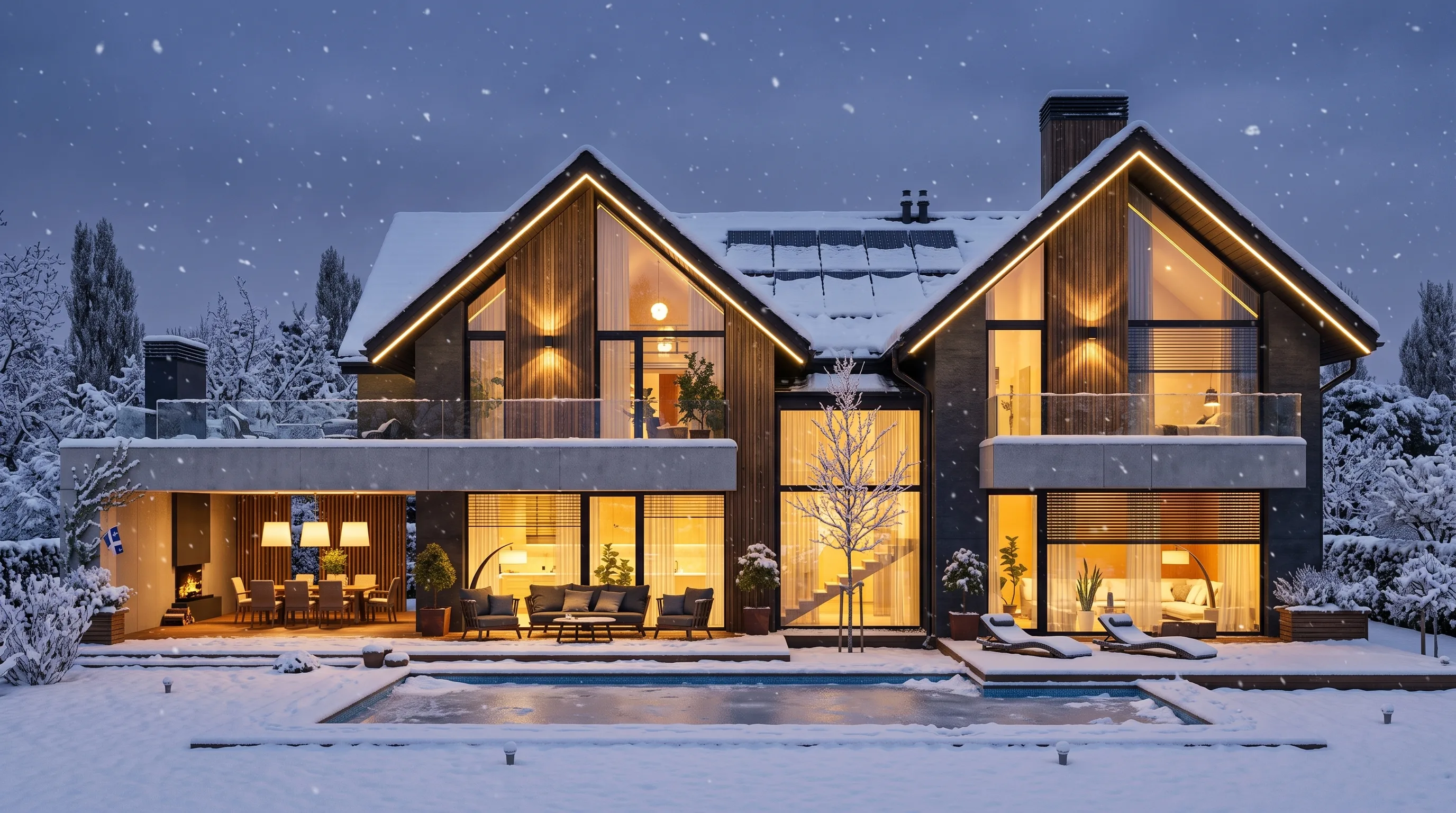
Nothing, if the hardware is rated for it. A permanent system stays outside and powered from November through April: it is rated IP68 and −40°C, while a southern Québec January averages about −10°C by day and −21°C overnight, for a monthly mean of −15°C. That margin is the whole difference between permanent lighting and a seasonal string you take down in January.
Quick reference
- Ingress rating: IP68
- Temperature rating: −40°C
- January, southern Québec: −10°C day, −21°C night, −15°C mean
- Annual snowfall in Montréal: about 175 cm
- Below freezing: November through March, on average
- Exposed wire: none
What IP68 actually means
It is a rating defined by IEC 60529, adopted in the United States as ANSI/IEC 60529. Two digits, two separate tests.
The first digit, 6, is the top of the solid-objects scale — the level the standard verifies in a dust chamber (clause 13.4).
The second digit, 8, is continuous immersion. The standard titles that test “continuous immersion subject to agreement” (clause 14.2.8): prolonged submersion under conditions agreed between the manufacturer and the user. For a roofline, that means driving rain, melting snow and standing water are not edge cases. They sit well under what the rating covers.
What −40°C means
It is the minimum temperature the hardware is built to operate at, not merely survive. A −25°C January night in southern Québec is not an event for the system. It comes on at the scheduled minute the same way it does in July.
Cold is actually kind to LED electronics. Heat is what ages a junction, not frost. The hardest month for exterior lighting in Québec is not January — it is July.
Freeze-thaw is the real story
Ouranos defines a freeze-thaw event as a day when air temperature crosses above and below 0°C within 24 hours. That cycle is what we see pull seasonal hardware apart — clips off a gutter lip, cheap housings split, strings pulled loose.
A permanent system answers that with construction rather than with a rating. The rail is fastened into the soffit, there is no exposed wire anywhere on the run, no extension cord across the roof and no plastic clip living on a gutter lip. Nothing comes off because nothing is hooked on.
Snow, ice, and those 175 centimetres
Montréal gets roughly 175 centimetres of snow a year, and some of it ends up on the roof and then as icicles at the edge of the overhang. The rail sits back under the soffit, so the ice forms in front of the optics rather than on them.
Here is the honest part. A sheet of ice releasing off a roof can take a gutter with it, and anything mounted beside that gutter goes too. Damage from storms and other extreme weather events is excluded from the warranty. It is rare, it is not zero, and nobody should sell you a system as weatherproof against everything.
Landscape is the more exposed case. A ground fixture lives under packed snow, road salt and the snowblower. That is one reason landscape lighting products carry a 3-year warranty rather than 12.
What winter really changes is the usage
The sun sets early, the facade runs longer, and this is the season the system works hardest. It is also the season you no longer climb anything: holiday scenes change from the app without going outside. The holiday lighting page shows what that looks like, and the project gallery has real houses under snow.
Common questions
Should I shut the system off during a storm? No. It stays powered and keeps its schedule. After an outage the controller restarts on its own.
Can ice break the rail? The rail is aluminum and seated under the overhang, so normal buildup does nothing to it. A sheet of ice tearing off a gutter is an extreme weather event, and that is excluded from the warranty.
Does cold shorten LED life? No, the opposite. Heat is what wears an LED down; cold is easy on it.
Does snow on the roof block the light? No, because the light throws downward onto the facade rather than up at the sky. The exterior lighting page shows the four areas we light on a house.
Do you cover my town in winter the same as in summer? The territory is the same year-round. The municipality list is on the service area page, and more answers are in the FAQ.