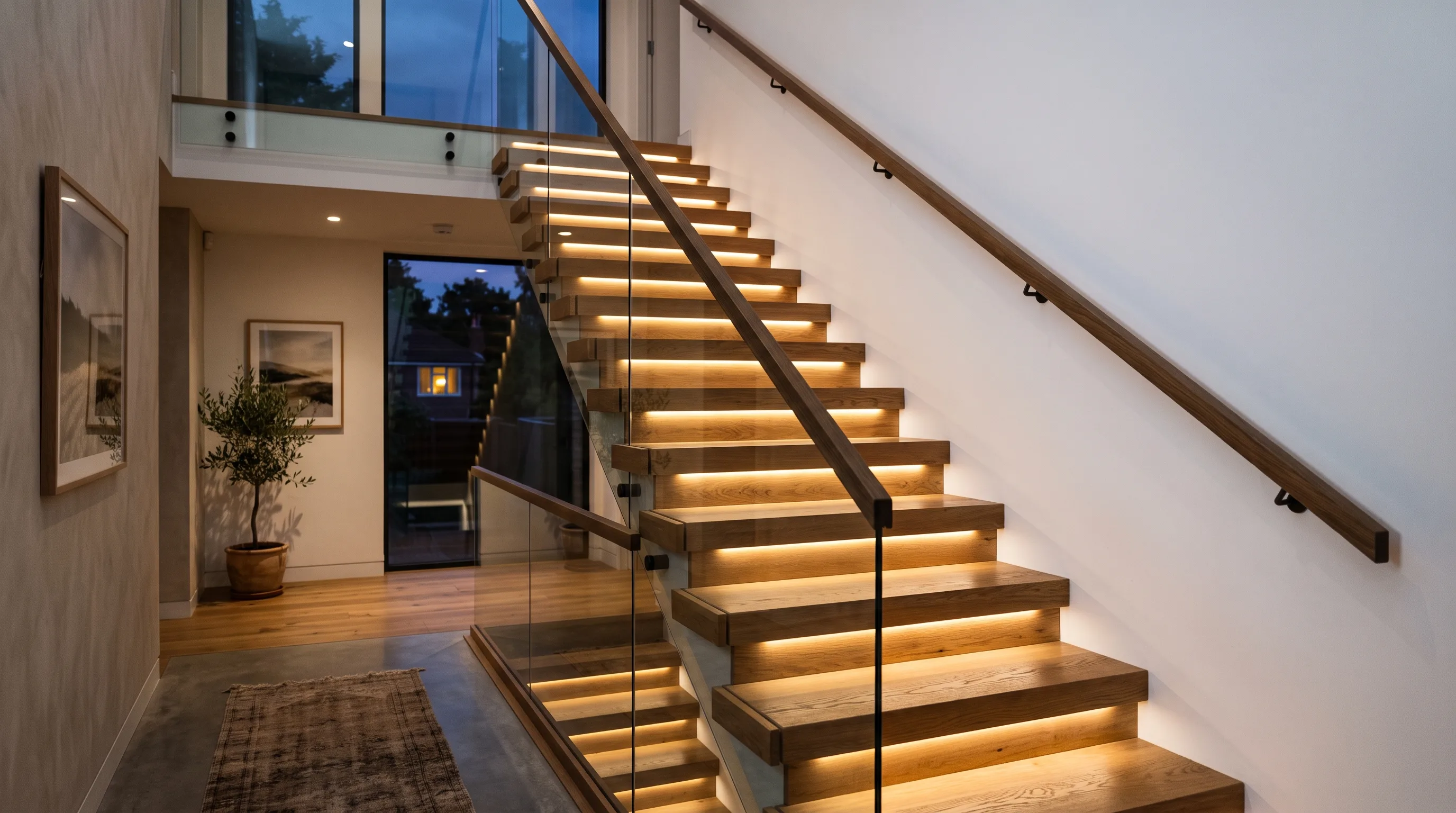
A staircase gets lit with a full-width light bar under each nosing, not with pucks set into the side wall. The whole difference fits in one sentence: a bar hidden under the nosing lights the entire tread and stays invisible to whoever is coming down, while a puck lights a circle and puts the source in your eye.
Quick reference
- One bar per tread, the full width of the nosing, aimed down.
- Hidden source — you see the lit tread, never the diode.
- 1 to 100% dimming per zone, with no visible flicker.
- Always light bars indoors, never pixels — white quality and fine dimming matter more in a room you live in.
- Warranty — 3 years on light bars, 12 on controllers, labour a separate 3.
Why the stairs, before any other room
Stairs are the one place in a house where lighting has a job before it has an effect. In the Public Health Agency of Canada’s analysis of the Canadian Community Health Survey, 12% of fall-related injuries among Canadian seniors happened “while going up or down stairs or steps” (Health Promotion and Chronic Disease Prevention in Canada, 2015).
That figure does not say lighting fixes it, and we are not going to pretend it does. It says a staircase deserves better than a hall fixture nobody switches on because the switch is at the bottom.
The bar versus the puck
A wall puck throws a circle. Fit one every third tread and you get alternating bright and dim bands across a surface where a foot has to land in a specific place. Worse, the puck sits at eye height for anyone climbing: the source is visible, so it glares, and the eye adjusts to the light instead of to the step.
A bar under the nosing does the opposite. It hides behind the lip, throws down onto the tread below, and gives you the real depth of the step — which is the information the foot is looking for.
Two install details decide whether it looks built-in or stuck on. Set the bar back far enough under the lip that a descending eye never crosses the diode. And run it the full width of the tread: a short bar leaves the last few inches dimmer than the middle, which is exactly the side your hand is on when it is running along the rail.
Glare and dimming
A staircase does not need to be bright. Turned very low, the stair zone is enough to come downstairs at night without switching on the hall fixture, and you bring it up when the house is full.
This is where the quality of the bar shows. Ours dim from 1 to 100% with no visible flicker, which matters in an open stairwell that reads into the living room, and it matters on camera — flicker the eye misses often shows up in video. It is the reason we do not fit cheap LED tape, and the interior lighting page covers the rest of the system.
The honest limit
Not every staircase suits an under-nosing bar. A tread with no overhang — a flush nose over a closed riser — leaves nowhere to hide the channel, and a carpeted stair has the same problem. In those cases the alternative is a line in the stringer or under the handrail, which is a different look, not the same one.
The other constraint is the wire route. In old plaster you plan the path during the visit instead of discovering it mid-job. Plenty of Montréal houses have beautiful stairwells and walls that would rather not be opened.
Outside, same principle
Exterior stone steps get the same treatment: a strip under the nosing throwing down, so you see where your foot lands and the wall appears to float. The difference is the product — outdoors the fixtures are sealed to IP68 and tested to −40°C. That part lives on the landscape lighting page, and there are real examples in our project photos.
Common questions
Does it glare on the way up? No, because the source sits under the nosing and throws down. Climbing, you see the lit tread and not the light itself.
Does it flicker when dimmed low? No. The bars dim from 1 to 100% with no visible flicker, on camera included.
Can it go on a staircase that is already finished? Yes. What needs planning is the wire route, and that gets settled on the visit rather than during the job.
What is the warranty on stair bars? Three years on light bars and twelve on controllers. Labour is a separate three-year warranty: inside that window, a visit for a covered part costs nothing.
Can I run colour on the stairs? Indoors we fit dimmable white bars rather than pixels, precisely for the quality of the white. Colour belongs outside, with holiday lighting.