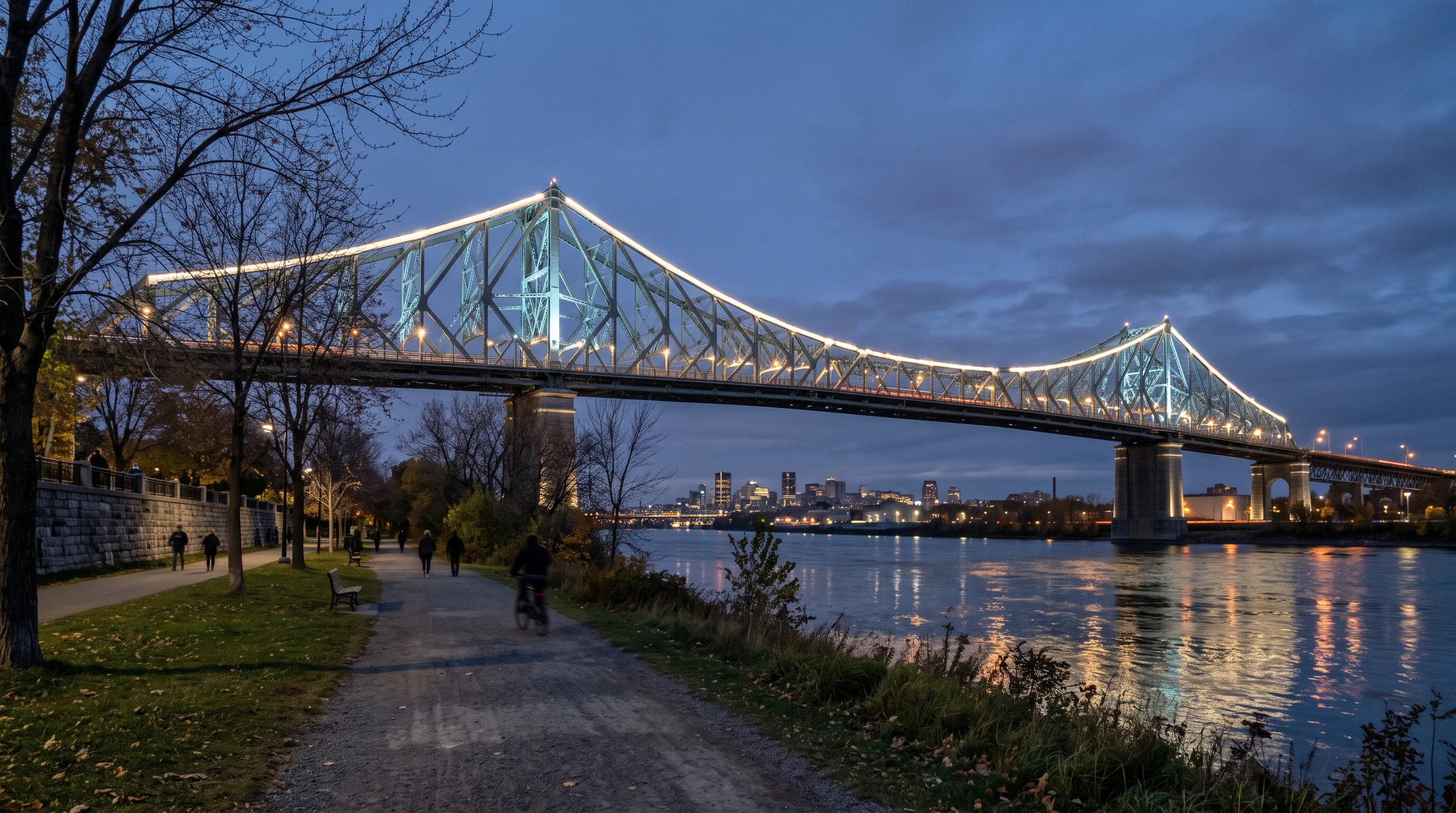
Montreal has a permanent lighting installation you can go look at tonight, and it isn’t on a house — it’s a steel bridge above the river, lit on its own structure without washing out the sky. The Jacques Cartier Bridge’s “Living Connections” illumination, designed by Moment Factory and six local partners for The Jacques Cartier and Champlain Bridges Incorporated (JCCBI), is a masterclass in what it means to light a structure with control: 10.4 km of cabling, 2,807 fixtures — projectors and tube lights — and light aimed at the steelwork to minimise what escapes into the sky. Most of the principles hold just as well at the scale of a Montreal home.
A nightly landmark designed as a system, not a string of lights
The bridge isn’t decorated for Christmas; it’s lit every night of the year on a 365-colour calendar. In spring it settles into green, in summer orange, in autumn red, in winter an icy blue. Every hour of the night, five minutes of animation translate the city’s mood from real data — the weather, the traffic, the colour of the sky.
That’s the heart of the lesson. A permanent installation doesn’t need to be “off” to be restrained; it needs a programme that decides what comes on, when, and how bright. At home, the same idea lives in the controller of a soffit rail — warm white almost every evening, colour a handful of nights a year, all handled on a schedule at sunset.
The light is aimed at the steel, not the sky
The most important detail of Living Connections isn’t in the photos. Per JCCBI, the light is aimed at the bridge’s own structure — the turrets, the piers, the interior core and the exterior skin. You draw the building and limit the light that would go elsewhere, out of concern for the starry sky.
That’s exactly the geometry of a soffit-mounted rail. Light travels down across the facade and traces the roofline — aimed at the house rather than up at the sky or across at the property line. Saint-Laurent, the first municipality in Montréal to adopt a light-pollution bylaw, asks for the same thing in writing: direct light flows towards the ground. That bylaw covers commercial, institutional and large residential buildings rather than single-family homes, but the principle is the one we build to on every house — our landscape lighting page shows how we apply the same orientation at ground level.
LED lifespan, here and at the bridge
The bridge is lit in LED, and JCCBI’s stated fixture lifespan is 50,000 hours — the same order of magnitude we use for residential components. That longevity isn’t about the location; it’s the LED technology at work, whether on a federal bridge or along a cornice. That’s why a permanent system pays for itself over years rather than behaving like a throwaway string every winter.
A project that reads as a local demonstration
Whether you’re on the island or the South Shore, the Jacques Cartier Bridge runs its programme every night of the year, in public and for free. For a homeowner wondering whether “permanent lighting” means “Christmas lights that stay up all year,” the answer is in this bridge: controlled, programmed light that never becomes a nuisance.
If you live in a municipality in the wider region and want to know how we bring that same rigour to a house, the list of towns we serve is on the service area page.
Common questions
Is the Jacques Cartier Bridge lit every night? Yes. The “Living Connections” project lights the bridge on a 365-colour calendar that follows the seasons, with short programmed animations each hour. It runs all year, not just during the holidays.
Does it create light pollution? The design aims the light at the steel structure — turrets, piers and trusses — to minimise loss into the sky. It’s the same downward-facing principle we apply to a residential soffit rail.
How much hardware does lighting a bridge take? Per JCCBI, the illumination uses about 10.4 km of cabling, 2,807 fixtures — projectors and tube lights — and nearly 10,000 mounting systems. At house scale we’re talking a few dozen points and a single controller.
Can a residential install last that long? On the same order, yes. The LEDs are built to last (on the order of 50,000 hours), and controllers and pixels carry a 12-year warranty, light bars and landscape lighting 3, with labour covered for 3.