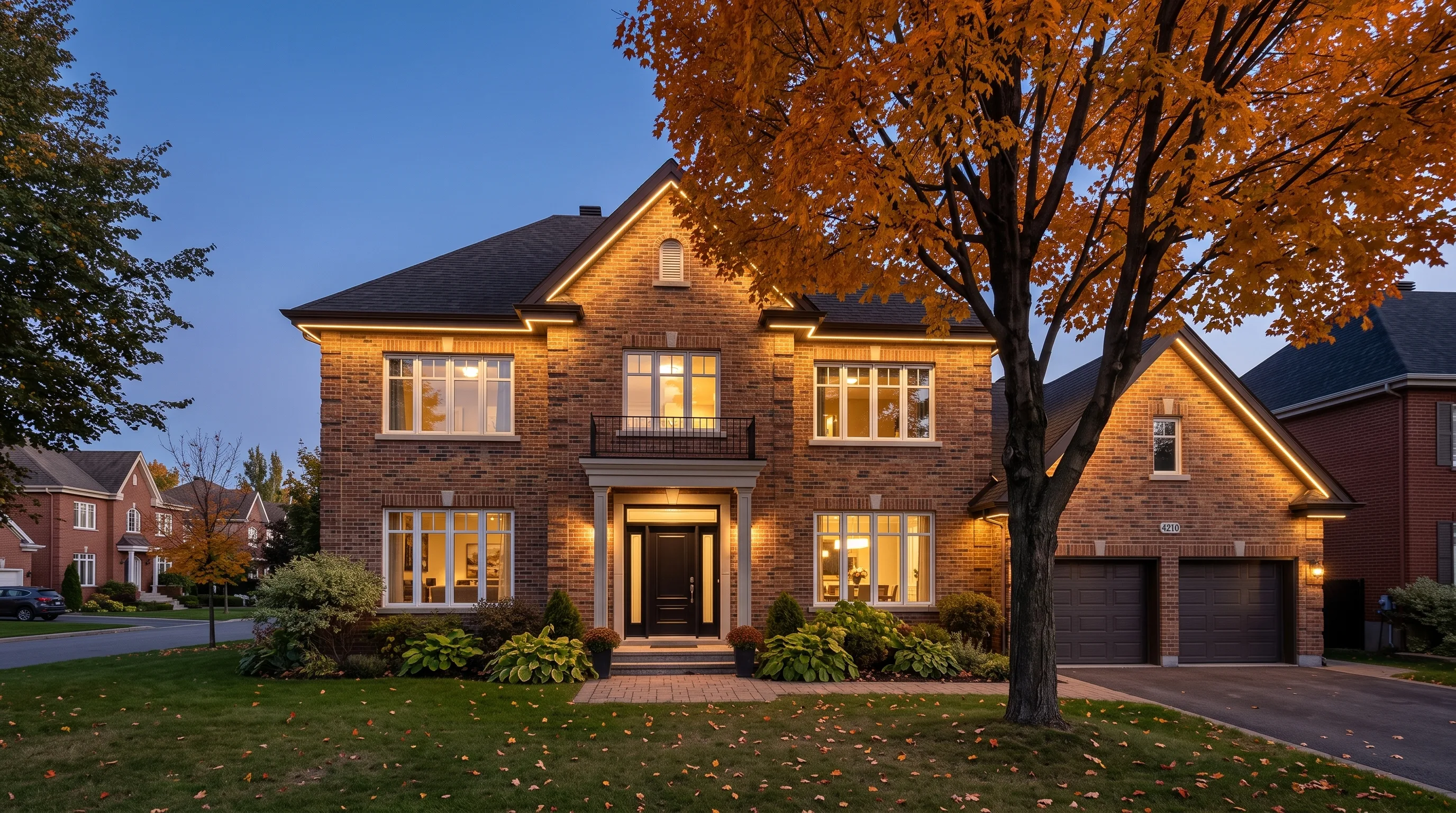
In 2026 the question “is my exterior lighting compliant?” increasingly points at one standard: BNQ 4930-100, published by the Bureau de normalisation du Québec and updated in its R2023 version. On Montreal island, the Saint-Laurent borough was the first to make it the basis of a light-pollution bylaw. Elsewhere in Quebec, Hudson has had its own exterior-lighting bylaw since 2012, written its own way. The good news for anyone installing or planning permanent lighting: a soffit rail that directs its light downward already answers the central principle these texts keep repeating.
What the norm says, in one line
BNQ 4930-100 governs exterior lighting to reduce light pollution through four levers: orientation, quantity, colour and time. According to the City of Montreal, Saint-Laurent’s bylaw draws on it to define when bluish light is allowed, to aim light flows toward the ground, to reduce certain lighting after 11 p.m., and to cap the amount of light by land use.
The most universal principle, by far, comes down to three words: light goes down. That’s the same geometry as a soffit-mounted rail, which throws light onto the facade instead of letting it cross the hedge into your neighbour’s yard.
Who’s affected in Saint-Laurent — and why your house usually isn’t
Under the Saint-Laurent borough’s bylaw, single-family, two-unit and multiplex dwellings (h1, h2, h3 — up to four units) are explicitly excluded. The new rule targets industrial, commercial, institutional and larger residential buildings.
That doesn’t mean a homeowner can ignore the trend. First, municipalities don’t all apply the same standard — some require a permit, others don’t. Second, the norm will remain the reference everything converges on: installing today according to common sense (light aimed down, a sensible colour temperature, no spill onto the neighbour) means not having to change anything when your town tightens its own bylaw. For the list of towns we serve, check the service area page.
What it means for a soffit-mounted rail
A system like ours is built for exactly that orientation. Light is emitted downward, along the roofline, drawing the facade without escaping into the sky or the neighbour’s lot. It’s the configuration that most naturally satisfies the spirit of the norm.
Landscape lighting is the one place to be careful: a ground fixture lighting a tree necessarily sends some light upward, and that’s where orientation and fixture shielding matter. We account for it at the design stage, on the landscape lighting page. For holiday lighting, several bylaws allow exceptions or temporary periods — but not all of them, and not in the same way.
Why now is the moment, autumn 2026
September is the time to settle this before winter. After the first snow, a Monday morning on a glazed driveway isn’t the same surface as in autumn for climbing and measuring a roofline. If you’re planning permanent lighting, this is when we can walk the full perimeter, show you a demo, walk you through the quote and measure the soffits — before snow covers the trim lines.
Common questions
Do I need a permit to install permanent lighting in 2026? It depends on your municipality. Some require one under their zoning bylaw, others don’t. Ask your town’s urban planning department, with your exact address.
Is a soffit rail compliant with the new rules? In almost every case, yes. Its light is directed down across the facade, doesn’t spill onto the neighbour, and uses a sensible colour temperature. That’s the geometry the BNQ 4930-100-inspired bylaws ask for.
Is colour banned? No. The regulation targets excessive bluish light and light aimed at the sky, not using colour on your own facade on holiday evenings. Many municipalities have rules about timing (reduction late at night) or temporary exceptions.
Does this change the price? No impact on pricing. For a residence, a project runs around a $3,000–5,000 Starter, a $5,000–15,000 Standard, and a $20,000+ Complete — often beyond $50,000 — for exterior, interior and backyard. Designing in line with a bylaw doesn’t cost more; it’s just doing it right.