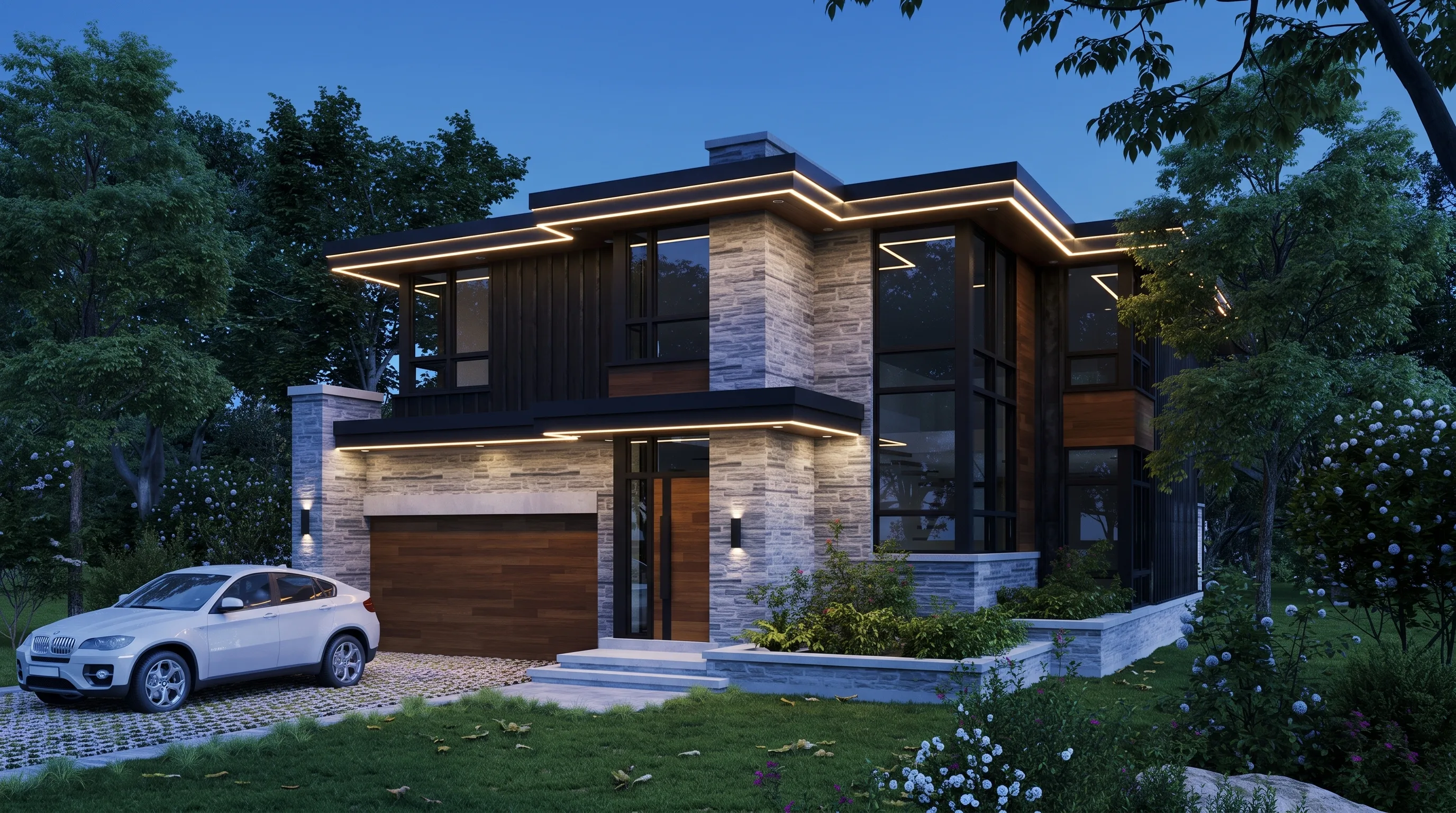
Permanent architectural lighting is a line of LEDs mounted permanently under a home’s soffit, following the roofline and the building’s other edges, with no exposed wire and nothing to take down. It stays up twelve months a year. In daylight you barely see it; after dark it draws the shape of the building. If you arrived here comparing it to Christmas lights, the honest reframe is that this is lit architecture, not decoration that happens to be left up.
Planning lighting for a shop, restaurant or other business property? Our permanent commercial lighting service covers facades, signage and interiors, with a system designed for your building.
Quick reference
- An aluminum rail fixed under the soffit, available in more than 120 finishes to match the cladding.
- RGBW LEDs: red, green, blue, plus a dedicated white chip rather than a mix — so the everyday warm white stays a white.
- Four jobs in one system: security, architectural, colour, events and holidays.
- IP68 rated, tested to −40 °C, cULus Listed for residential installation in Canada and the United States.
- 50,000+ hour rated life, roughly 15 to 23 years.
- Warranty: 12 years on controllers and pixels, 3 years on light bars and landscape lighting. Labour is a separate 3-year warranty.
What it is not: Christmas lights
A string light is temporary by design. It goes up in November, comes down in January, tangles in a bin, and one dead bulb takes a section with it.
The permanent rail is the opposite on every one of those points. It is mechanically fixed to the building, wired inside the rail, tied to a controller, and it does not move again. Nothing gets stored and nothing gets rehung. More importantly, it is not built around a holiday: most of the year it runs warm white, and that is the main use rather than the exception.
What it is not: ground spotlights
Spotlights push light up a surface from the ground. They wash a wall, show every flaw in the stucco, and throw part of the beam into the sky and your neighbour’s windows.
Permanent lighting works the other way. The light leaves the soffit edge and falls down the facade. The throw is short and controlled, the wall gets a grazing light rather than a frontal wash, and the housing reads as a line along the roof edge rather than as a fixture.
It is not a universal replacement. A mature tree, a stone walkway or a planting bed still needs a system at ground level — that is landscape lighting, a separate install with its own three-year warranty.
What it is not: a rented seasonal install
The seasonal model is a crew every autumn, rented strings, and a removal in spring. You pay each year, you own nothing, and the house sits dark for eleven months out of twelve.
A permanent system is a one-time purchase attached to your building. The real difference is not the price — it is that the system earns its keep the rest of the year. December becomes one use case among several.
The four modes of one system
Security. A bright bluish white, on the schedule and the zones you set from the app. This is the mode that replaces the fixture screwed to the corner of the garage.
Architectural. Dimmed warm white. This is the mode you will use nearly every night: it picks out the roofline, the peaks, the columns and the backyard, and makes a house look finished rather than decorated. The exterior lighting page covers those four zones in detail.
Colour. One solid colour, or a colour per zone. Useful for marking an occasion without installing anything.
Events and holidays. Full scenes set in the app: the house lights itself on schedule and switches off at the hour you set. That is where holiday lighting lives now — in a setting, not in a box in the basement.
So one permanent system covers what spotlights, holiday lights and part of your security lighting used to do separately. That is the central argument, and it is also why the budget maths works out differently than for a decoration.
How the rail actually goes up
The aluminum rail sits tight against the soffit, the trim or the roof edge, aimed down. The LEDs sit inside the profile, which protects them from direct snow load and from summer sun.
Wiring runs inside the rail itself and then follows cavities that already exist inside the building. No wire crossing the brick, no extension cord on the porch, no staples in the wood. That is what “zero exposed wire” means, and it is the first thing most people check during a visit.
The rail comes in more than 120 finishes, and we pick the one closest to the soffit. Done properly it reads as trim: from the street in daylight, you do not notice it.
The same idea moves indoors as cove rather than soffit — that is interior lighting. Outside, one field detail comes up constantly: every roofline and soffit gets lit, including the return above the porch, not just the highest roofline. A house lit only at the top looks cut in half after dark.
What the acronyms mean
RGBW is red, green, blue, plus a separate white chip. Without that fourth chip, “white” is three colours mixed, and how it turns out depends on the recipe: the US Department of Energy notes that a given white can be built many ways from three or more LED primaries, and no two of those recipes produce exactly the same appearance or colour rendering. Since warm white is the mode you will use most, that chip is the one that matters most.
IP68 describes the enclosure: no dust ingress, and resistance to prolonged immersion. −40 °C is the tested temperature, which matches the real extremes of a Québec winter. cULus is the combination UL Listing mark for Canada and the United States, and it indicates compliance with both countries’ requirements; our residential product is Listed for residential installation in both. Vision Bleu also holds RBQ licence 5864-7108-01.
The residential controller is capped at 450 W — the ceiling for the whole system at full brightness with every zone on. It handles zones, schedules and scenes, and is driven over Wi-Fi from the app.
What it costs, and what it does not solve
Residential projects land in three broad bands: $3,000–$5,000 for a starter project, $5,000–$15,000 for a standard one, and $20,000+ — often above $50,000 — for a complete home with several systems, exterior, interior and backyard. What moves a project within that range is roofline length, number of storeys, peaks, access and the number of zones. There is no reliable per-foot number — the on-site visit is exactly what settles it.
And the honest limit: depending on the facade, the line may be built from light bars rather than an addressable pixel rail. Plenty of facades are light bars only. In that case the warranty is three years, not twelve, and colour scenes do not apply the same way. That gets decided at the visit, not at signing.
Common questions
Can you see it during the day? Barely. The rail mounts under the soffit edge in a matched finish; from the street it reads as trim.
Does it stay up through winter? Yes, that is the whole point. Components are IP68 and tested to −40 °C, and nothing is removed in spring.
Can I light only part of the house? Yes. The system is split into zones, and each zone has its own colour, brightness and schedule.
How long does it last? The LEDs are rated for 50,000+ hours, roughly 15 to 23 years of normal use. Controllers and pixels carry 12 years of warranty, light bars 3.
Does it replace my yard lighting? No. The rail lights the building. Trees, walkways and beds need a separate ground-level system. The services page shows where each system starts and stops, and the FAQ answers the rest.