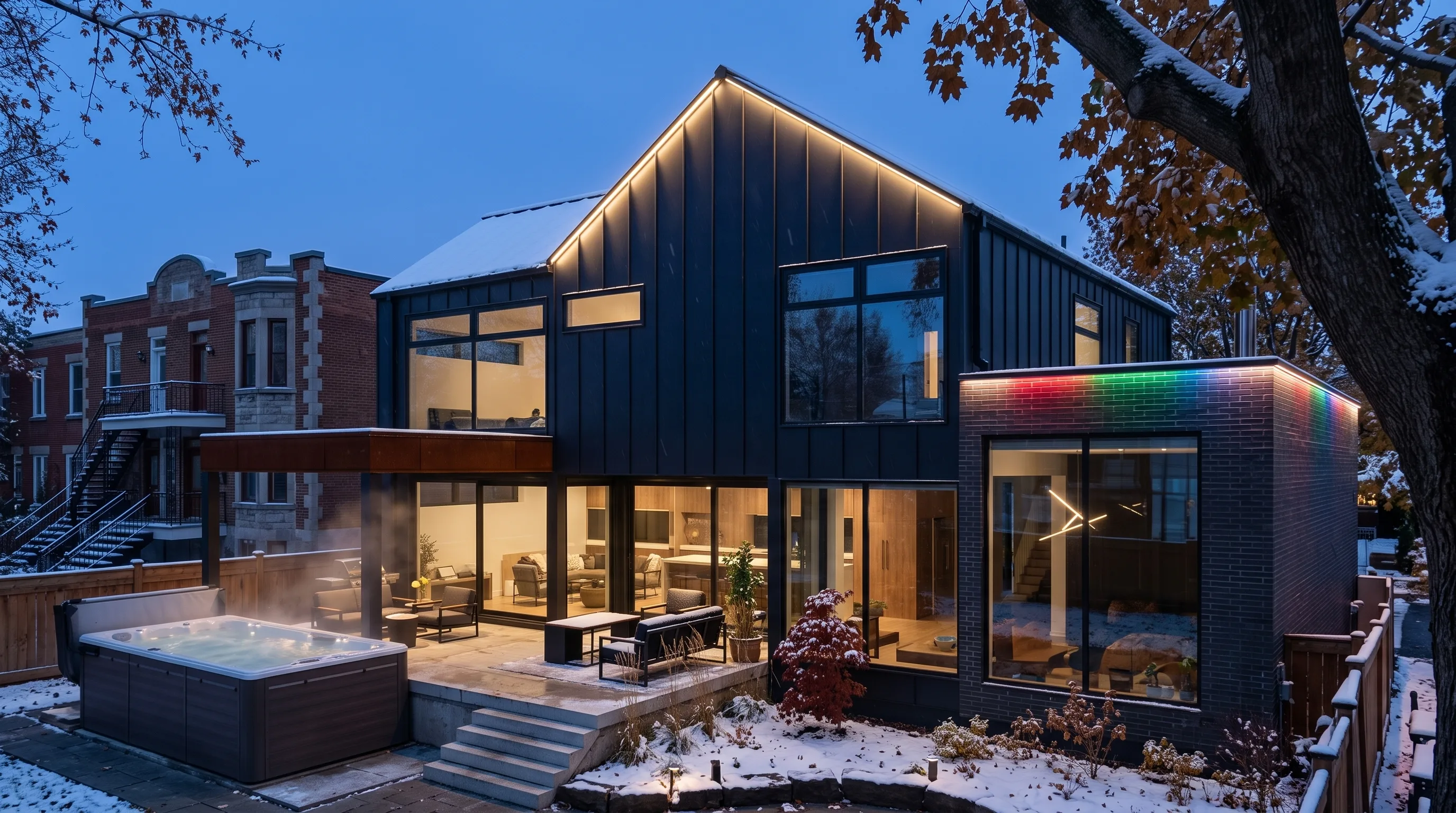
If you are comparing this to Christmas lights, you are pricing one night of the year — a permanent system is a fixed line on your building that can take any colour on any evening. Blue and white on June 24, orange on October 31, red and white on July 1, one colour for a birthday. You build the scene once, it fires on the date you set, and the house goes back to warm white the next night.
Quick reference
- Québec’s National Holiday (June 24) and Canada Day (July 1) are both statutory holidays in Québec — two obvious scenes to schedule ahead.
- Halloween: orange on the roofline, October 31.
- Valentine’s Day: red and pink, February 14, on one zone rather than everywhere.
- Game night: blue, white and red, alternating by section.
- A birthday: one colour, one evening, set in advance.
- Every other night: warm white, RGB-WW, with each zone set separately.
Which holidays actually earn a scene?
The ones on a fixed date. June 24 and July 1 are statutory holidays here, so the street is full and people are home in the evening — a blue-and-white facade on Saint-Jean gets noticed in a way a flag on the porch does not.
Halloween is the easiest one to get right: a single colour, orange, across the whole roofline. Valentine’s works in red and pink, but on one zone instead of the entire house.
Then there are the dates that belong only to you. A birthday, a graduation, someone coming home. That is where 16 million colours stops being a spec sheet line and starts being useful — you pick the exact colour, not the nearest one.
How a scene is actually built
A scene is not one colour. It is one colour per zone: roofline, peaks, columns, porch, stairs, each set separately with its own brightness.
Two things worth knowing before you design one. Two alternating colours read better than five — from the street, a busy scene turns to mush. And your cladding colour matters: on red brick, a red scene nearly vanishes. Put the red on the columns, keep the roofline white, and the contrast comes back.
Peaks are visible from further away than the porch is. When a scene has only one strong colour in it, that is where the colour belongs. The exterior lighting page walks through the four areas we light on a home’s exterior.
The schedules do the real work
Scheduling is the part nobody anticipates and everybody ends up using. You set warm white from sunset to 11 p.m., every night. You add a scene for June 24, one for October 31, one for July 1. They start and stop on their own.
On a game night there is nothing to schedule at all: open the app, pick the scene, done. That is what “one tap” means here — nothing to hang, nothing to take down.
What you will actually use
Be honest about the ratio. Most nights your house will sit in dimmed warm white, and that is the point — it is the setting that makes a facade look finished rather than decorated. Colour scenes are maybe fifteen or twenty evenings a year.
Buy the system for the colours alone and you are paying a lot for fifteen evenings. What carries it is the everyday warm white, the overnight security setting, and never spending a December Saturday on a ladder. The colour is a real bonus, not the reason. Our project gallery shows both faces of the same system, and holiday lighting covers the December side in detail.
Common questions
How do scenes work? A scene is a set of colours saved in the app, targeting the zones you choose. You can edit one later — nothing is locked in at install, there is no service call to book and no charge for changing a scene.
Can I change the colours without redoing the schedule? Yes. The schedule and the scene are two separate settings, so you can keep your warm-white schedule and swap only the evening scene.
Does it work with my voice assistant? Voice and smart-home setups are possible. Ask us during your consultation and we will recommend what works best with your system — rather than buying anything on that basis first.
Does running colour wear the LEDs out faster? We publish one lifespan figure — 50,000+ hours, roughly 15 to 23 years of normal use — and not a separate one per colour. What holds either way: colour scenes are a handful of evenings against a year of warm white, and the pixels and controller are covered for 12 years whatever colour they run, with labour covered for three.
Can I light only part of the house? Yes — that is what zones are for. Plenty of clients keep the porch in warm white year-round and reserve the roofline for scenes. The FAQ page covers the rest.