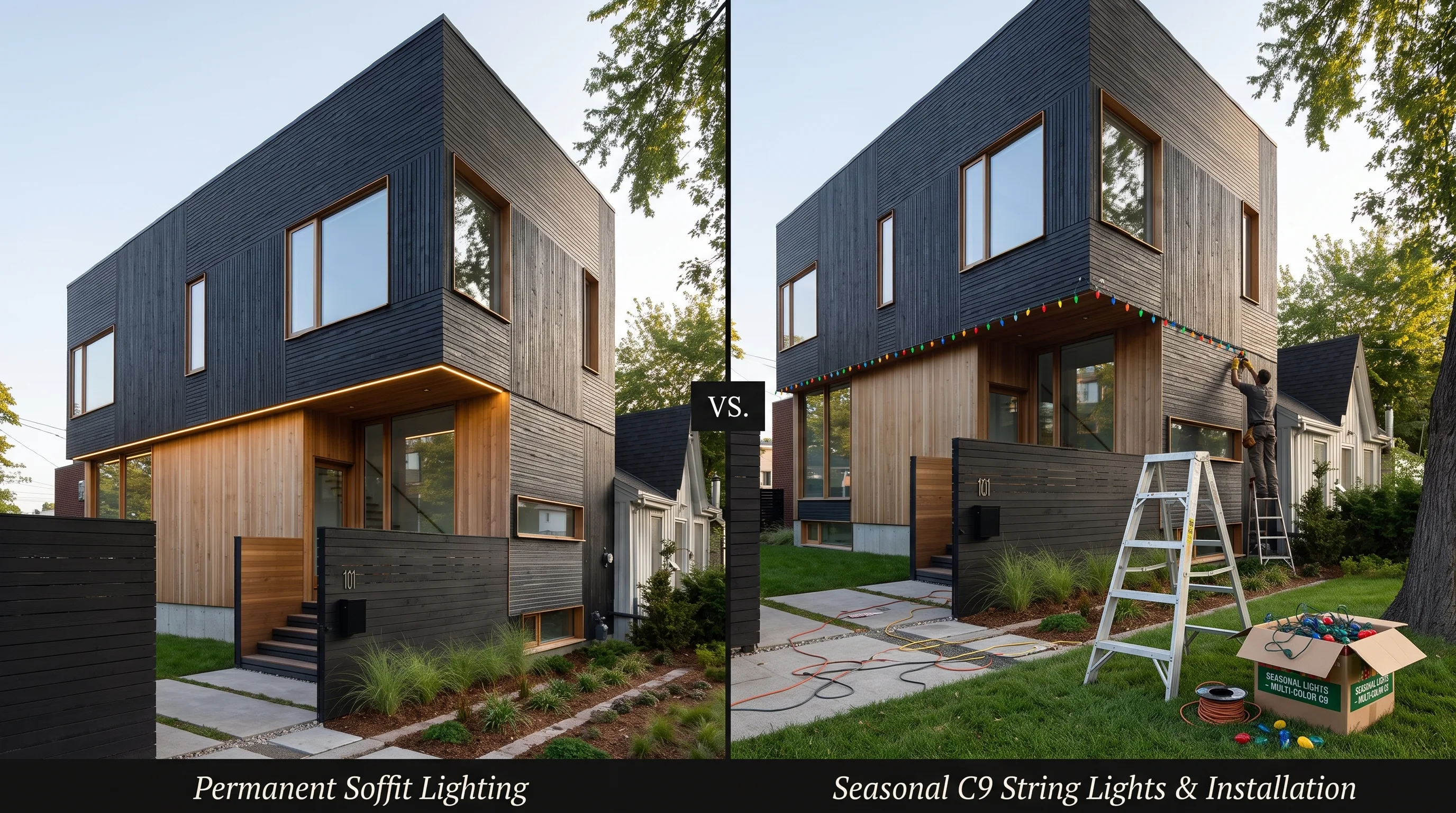
The whole difference is this: seasonal installation is a cost that comes back every year, and permanent lighting is a cost that comes once. A standard permanent project runs $5,000 to $15,000 for the house; a seasonal package gets requoted every autumn. So the decision depends less on the sticker price than on how many more winters you plan to spend at this address.
Quick reference
- Seasonal — billed annually, install and takedown included. Ownership depends on the package: lease and rental models keep the lights the installer’s; elsewhere they are the homeowner’s after the first year.
- Permanent — $5,000 to $15,000 for a standard project, once; a complete project starts at $20,000 and can pass $50,000. The rail stays on the house.
- The deciding variable — how many years you stay.
- Permanent warranty — 12 years on controllers and pixels, 3 years on light bars.
- The rest of the year — permanent works 365 days; seasonal works about six weeks.
What does a seasonal installer actually charge?
Most quote on request — but not all of them. A seasonal installer serving Greater Montréal (Blainville, Terrebonne, Saint-Jérôme, Laval, Montréal and the Rive-Sud) publishes the range it bills: $1,000 to $1,800 for a first season on a typical Québec bungalow or cottage, material, labour and the January takedown included. The same page says the rate drops in the years after, because the design is done and the fasteners are already in place. It is another company’s range rather than your price, but it is a Québec number and it is published.
Two other published guides give the wider shape of the math. A Canadian installer’s cost guide puts the common rate at $3 to $8 per linear foot of roofline in Canadian dollars, covering lights, clips, installation and takedown, with a first year around $650 to $1,200 for an average home in its market (Metro Vancouver). The same page notes that returning customers pay 30% to 50% less in later years, because only the labour is left to pay for.
A wider US cost guide updated in January 2025 puts the figure at US$2 to US$5 per foot and a typical project at US$250 to US$650. Those two describe markets other than ours — we cite them because they are real and checkable, not because they describe Montréal.
The honest way to do the math
Take what you paid last autumn, multiply it by the number of years you expect to stay, and compare that to the permanent project. That’s the entire calculation, and it doesn’t need to be more complicated.
Two things throw it off. The first is billing every year at the first year’s price: the first season is the expensive one because that is when the material is bought, and the years after it pay for labour — so the honest version is one first year plus the renewals you expect. The second is treating permanent lighting as a Christmas product, when it lights the architecture the other 46 weeks as well.
What seasonal does better
It asks for no commitment. You can change the look every year, change companies, or stop entirely — and if you’re selling soon, that’s the sensible answer.
It also handles what a rail can’t: the strand in the spruce out front, the wreath, the arch over the walkway. A permanent system outlines the building; it doesn’t decorate the yard.
What permanent fixes and seasonal never will
The ladder in December. The work happens once, in the autumn you install it, and nobody goes back up on the roof after that.
Timing, too. A seasonal crew arrives when it’s in your neighbourhood and comes back when it’s in your neighbourhood again; a permanent system turns red and green on December 1st because you scheduled it, and goes back to warm white on January 2nd with nobody on site. The holiday lighting page shows how that runs from one holiday to the next.
Then there are the other 46 weeks. The same rail carries the warm-white facade light all year, which the exterior lighting page breaks down zone by zone.
The detail installers know
What our crews find on a seasonal install is almost never a failed bulb. It’s the clip, and where it has to land. A shingle manufacturer’s own guide to hanging Christmas lights says never to puncture a shingle with a nail, staple or screw — even small holes can create leaks — and, where a roof edge has no gutter to clip onto, to attach to the drip edge or the shingle carefully enough to “avoid lifting the shingles in a way that breaks the sealant bond to the shingle below it”. That is a calculation the roof takes again every autumn.
Permanent rail is fixed under the roof overhang, into the soffit or the trim — never through the shingles — sealed to IP68 and tested to −40°C. It’s a fastening difference before it’s a lighting difference.
Something else our crews see on site: a house that has taken clips every year for a decade often carries marks along the cladding. That doesn’t change anyone’s price, but it’s worth looking at before renewing a seasonal contract for an eleventh season.
If you’d rather compare against a real number than a regional range, a free on-site estimate gives you the price for your house, anywhere in the service area.
Common questions
How many years before permanent costs less? It depends entirely on what you pay each autumn, and nobody can tell you without your invoice. Do the multiplication with your own number — it’s the only version of the calculation that means anything.
Does permanent lighting do red and green like Christmas lights? Yes. Every pixel is addressed separately, so alternating colours, gradients and motion are all available — 16 million colours in total, and a different scene for Halloween or Saint-Jean.
Can you see it during the day? The rail is aluminum, available in more than 120 finishes, and mounts under the roof overhang with no exposed wire. From the street it reads as trim. Daytime examples are in our projects.
Can I keep my seasonal installer for the yard and go permanent on the house? Yes: the building on the rail, the trees and ground decorations handled the way they always were.
Should it be unplugged for the winter? No. The system is built to stay powered year-round, snow included. More maintenance questions are answered in the FAQ.