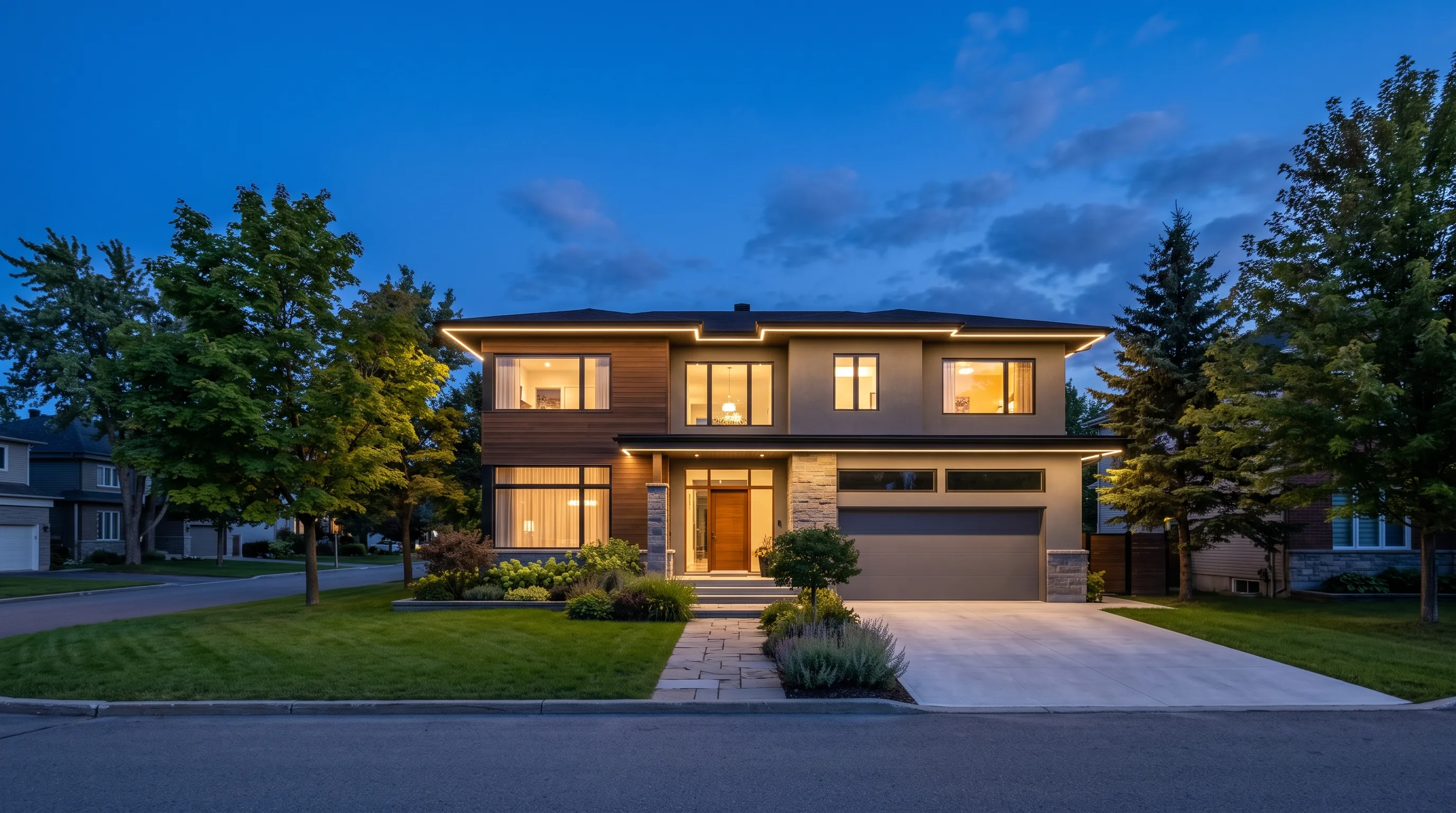
You can calculate exactly what your exterior lighting costs to run, because Hydro-Québec publishes the price. Under domestic Rate D, in force since 1 April 2026, energy is billed at “7,065 ¢ le kilowattheure” on the first tier and “11,142 ¢ le kilowattheure pour le reste de l’énergie consommée” — 7.065 ¢/kWh and 11.142 ¢/kWh. Everything else is arithmetic. Here are the five numbers that decide the answer.
1. The rate you’re actually billed on
Rate D is the ordinary residential rate — Hydro-Québec calls it “le tarif de base pour la majorité de la clientèle résidentielle”, the base rate for most residential customers. The rate schedule says it “s’applique à un abonnement pour usage domestique dans un logement dont l’électricité est mesurée distinctement […]” — it applies to domestic use in a separately metered dwelling. Its structure, as published in the official Tarifs d’électricité 2026, has three parts:
- 46.154 ¢ per day as a system access charge (“46,154 ¢ de frais d’accès au réseau par jour compris dans la période de consommation”)
- 7.065 ¢/kWh for first-tier energy
- 11.142 ¢/kWh “pour le reste de l’énergie consommée” — for everything above the tier
The system access charge is fixed. You pay it whether your lights are on or off, so it stays out of the calculation.
2. The calculation is one line
Watts × hours ÷ 1000 = kilowatt-hours. Then × the tier price.
Use your own wattage and run it. As arithmetic only: a system drawing 100 W for 6 hours uses 0.6 kWh a night. On the first tier that’s about 4.2 ¢ a night, or roughly $1.27 over 30 nights. On the second tier, about 6.7 ¢ a night — roughly $2.01 over 30 nights.
Those aren’t the numbers for any particular system. They’re the formula, applied to a wattage you swap for your own.
3. Which tier your lighting lands in
The first tier isn’t a fixed monthly cap. The rate schedule defines it as “le produit de 40 kilowattheures par le nombre de jours de la période de consommation” — 40 kWh multiplied by the number of days in the consumption period. Your lighting doesn’t consume in isolation; it adds to the household total for that period.
The practical consequence: if your total consumption is already past that threshold, every additional kilowatt-hour — lighting included — is billed at the second-tier price. If you want the conservative estimate, use 11.142 ¢.
4. The 2026 increase barely moved this number
It’s the year’s news, and for this particular line item it’s modest. The Régie de l’énergie estimates the domestic-class adjustment at “3,0 %” for the period from 1 April 2026 to 31 March 2027 — but that is a class average, and neither price above moved by exactly that amount.
Comparing Hydro-Québec’s own rate grid year over year tells you what actually happened: the first tier went from 6.905 ¢ to 7.065 ¢ (+2.3%), the second tier from 10.652 ¢ to 11.142 ¢ (+4.6%), and the daily system access charge didn’t move at all — 46.154 ¢ in both years.
So a lighting line billed on the second tier went up about 4.6%. On a two-dollar-a-month line, that’s about nine cents. A rate increase is real news for heating a house in Québec. For roofline lighting, it disappears into the rounding.
5. Where the money actually is
The expense of permanent lighting is at installation, not at the meter. A starter project runs around $3,000 to $5,000, a standard project goes from $5,000 to $15,000, and a complete project starts around $20,000 and up — often beyond $50,000 once exterior, interior and backyard are included.
That’s also why durability matters more than consumption in this decision. Our LEDs are rated IP68 and tested to −40 °C, with a lifespan of 50,000 hours and more, and the warranty covers 12 years on controllers and pixels, 3 years on light bars and landscape fixtures, and 3 years on labour. An unusually low quote doesn’t shrink your Hydro-Québec bill — it usually shrinks what’s covered.
If running cost were the real question, nobody would hesitate: it’s one of the cheapest lines in the house. The decision is made on design and hardware, which is what gets settled on site during the visit. Our exterior lighting page covers what actually gets installed, and the FAQ covers the rest of the process — including holiday lighting.
Common questions
What is the price of a kilowatt-hour in Québec in 2026?
Under domestic Rate D, in force since 1 April 2026: 7.065 ¢/kWh on the first tier and 11.142 ¢/kWh for the remaining energy consumed, plus a system access charge of 46.154 ¢ per day.
How do I calculate what my exterior lighting uses?
Watts × hours of use ÷ 1000 = kilowatt-hours, then multiply by the tier price. The only figure you need to supply is your system’s wattage.
Does the 2026 rate increase change anything?
For this line item, barely. The Régie de l’énergie estimates the domestic-class adjustment at 3.0% for the period from 1 April 2026 to 31 March 2027; in the rate grid itself the first tier rose 2.3% and the second tier 4.6%, while the daily access charge stayed flat. Applied to a monthly amount of a few dollars, the effect is measured in cents.
Am I paying the first or the second tier for my lights?
It depends on the household’s total consumption during the period. The first tier equals 40 kilowatt-hours multiplied by the number of days in the consumption period; beyond that, everything is billed at the second-tier price.