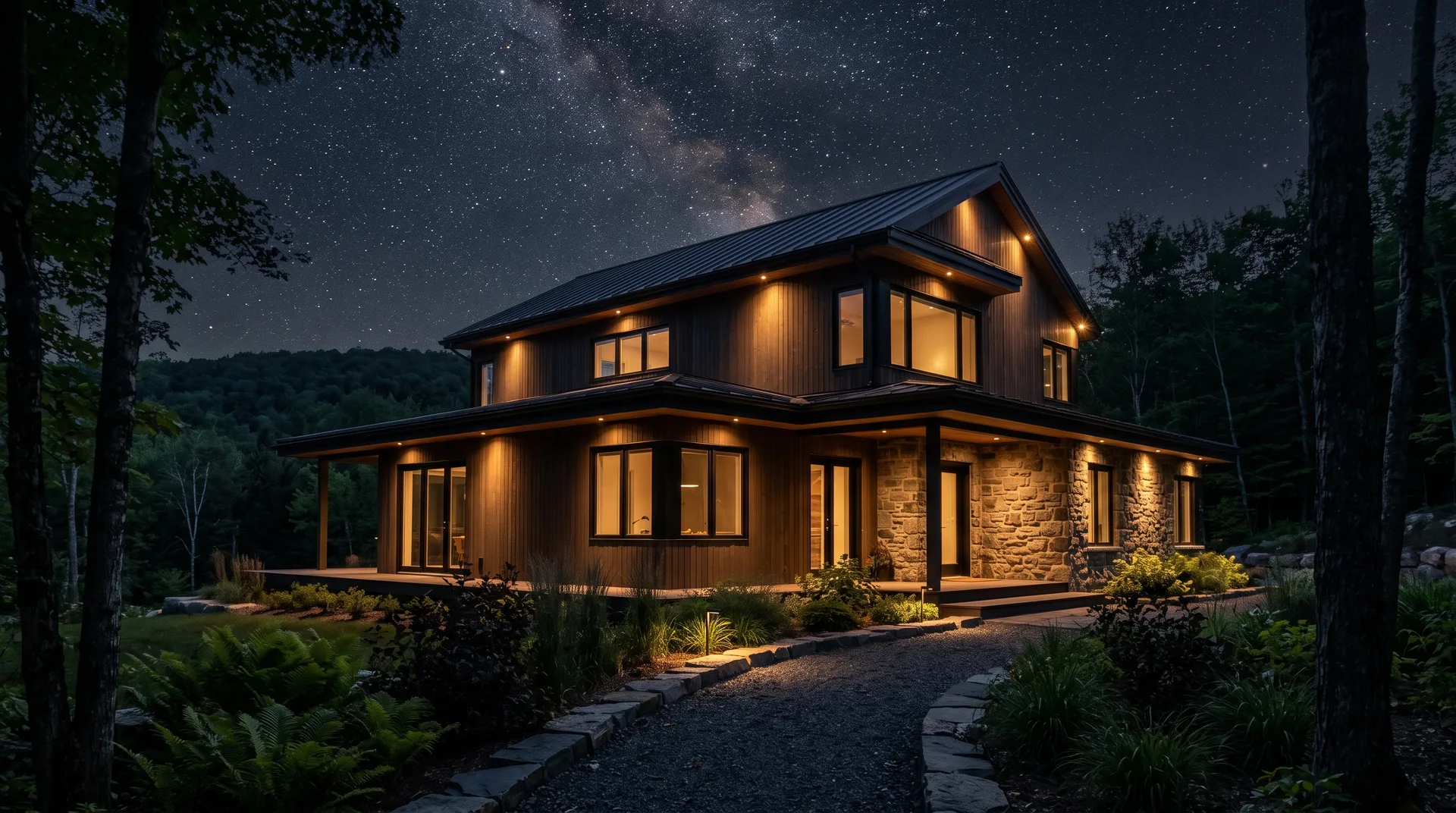
Inside the Mont-Mégantic International Dark Sky Reserve, the outdoor lighting regulations are not a simple instruction to light less — they govern where the light goes, what colour it is, how much of it a given use is allowed, and when it switches off or dims. Four axes, not one dimmer. That is what makes this territory worth reading if you are thinking about lighting your own house.
We suggest treating these regulations as a test bench. It is the first territory in the world to have been designated an International Dark Sky Reserve, and the reserve publishes its own tally of what the conversion achieved.
A region that converted its fixtures
The reserve’s own page puts it plainly: “On September 21, 2007, it was with great pride that the Mont Mégantic region was officially recognized by DarkSky International as the world’s first International Dark Sky Reserve!” The same page puts the territory at “approximately 50 km of radius around Mont Mégantic” and “about 5,300 square kilometres”.
It describes the work this way: the initial light-pollution abatement project “made it possible to convert more than 3,300 luminaires in a total of 17 municipalities”, and “this project alone is saving more than 1,700,000 kWh per year of energy, or approximately $200,000 of electricity, for the entire region”. The reserve’s verdict: “with a reduction of over 35% in light pollution, the region has truly regained its stars!”
A word about those numbers, because we would rather hand them to you as published than tidy them up. The same page carries a second, rounder version of the same result in its opening block: thanks to the initial conversion, “light pollution at the core of the Reserve has been reduced by more than a third while saving nearly 2 gigawatt-hour of electricity per year for the region”. And the DarkSky International profile, posted in 2015, gives lower figures for what it describes as the same retrofit: “Approximately 2,500 light fixtures were replaced, resulting in a 25 percent reduction of area light pollution and a reduction in energy consumption of some 1.3 gigawatt-hours per year.” Three tallies, two organisations, different publication dates. We give you the figures with the name of whoever published them, rather than electing one.
That same profile sets the starting point: the reserve’s municipalities adopted outdoor lighting regulations that helped control area light pollution “which had doubled during the preceding 20 years.” That is the context that explains why the answer focused on the fixtures themselves.
Three regulations, one line of reasoning
The regulations page notes that the rules “se divisent selon les 3 MRC qui la compose : Sherbrooke, le Haut-Saint-François et le Granit.” Each has its own text: by-law No. 1200 in Sherbrooke, No. 469-18 in Haut-Saint-François, and No. 2020-11 in Granit.
What we quote here comes from the summary the reserve publishes. The page says so itself — the exact and additional specifications live inside the regulation documents, which it notes are French-only. So none of this is a compliance opinion on any particular project.
Orientation: less than 1% above the horizon
This is the most transferable requirement. The summary asks fixtures to “Emit less than 1% of the luminous flux above the horizon, or less than 2.5% of the luminous flux if the luminaire is installed at a height less than” certain thresholds — 3.5 m in zone 1 of the Haut-Saint-François and Granit RCMs, 5 m in zone 2, and 7 m in Sherbrooke.
Notice what the rule measures. It is not about how much light you use; it is about where that light ends up. A fixture can be bright and still comply if almost nothing leaves above horizontal. The same page adds that “the use of visors or the installation of the luminaire under a canopy may be compliant if they meet the maximum percentages of light emitted above the horizon”.
On a house, that is exactly the logic of a roofline. Light starts at the soffit and travels down the cladding: the facade is the subject, and the sky is not supposed to collect the leftovers. Our exterior lighting page shows what that looks like on a real home.
Colour: 2200 K, and the blue fraction
On colour the text is stricter than most people expect. The summary states that light sources of 2200 K and less — which it equates to 10% blue light and less — are required for all exterior uses, followed by a list of exceptions. Among the uses allowed up to 3000 K, the summary names outdoor commercial display areas, non-residential building entrances in Sherbrooke, and any “light source emitting less than 1000 lumens” in the Haut-Saint-François and Granit RCMs.
The page also publishes the blue fraction source by source. For LEDs it lists 10% at 2200 K, 16% at 2700 K, 20% at 3000 K and 30% at 4000 K — and it lists older technologies separately, where the same colour temperature gives a different number: high-pressure sodium at 2200 K is 8% blue, halogen at 3000 K is 16%, metal halide at 4000 K is 35%. So the figure follows the technology, not just the temperature on the box. (One caveat worth stating: the English page’s LED row for 3000 K prints 22%, while the French rendering of the same table and both language versions of the exception block give 20%. We use 20%.) The page defines the measure as light emitted between 405 and 530 nanometres compared with the 380-to-730-nanometre range.
That table is useful well outside the reserve, because it converts an impression into a number. “Warm white” is not a specification; a colour temperature and a blue fraction are. If you are comparing systems, that is the question to ask — and the answer should be a figure, not an adjective.
Timing: what these rules do not switch off
This is the part that interested us most. In the Haut-Saint-François and Granit RCMs, the summary calls for “Lights off, including signs, after 10 p.m. or outside of operating hours.” In Sherbrooke: “Lights off, or reduced by at least 50%, after 11:00 p.m. or 30 minutes after hours of operation.”
But the same summary publishes the list of uses for which switching off is not mandatory. In Haut-Saint-François and Granit the English page lists “Pedestrian areas”, “Streets”, “Building entrances”, “Storage lots” and “Monuments and landscaping”. (The French page writes that third item as “Entrée et périmètre de bâtiment” — entrance and perimeter — so the French is the wider of the two. Same divergence as the LED table above.) In Sherbrooke the list covers “Building entrances and perimeters”, “Parking lots of multifamily housing” and “Streets”.
In other words, these regulations do not treat decorative light as the problem. They govern glare, spill, blue content and the lighting level each use is allowed — the summary devotes a whole section to light intensity and quantity, with maximum levels “modulated according to the type of use” — then leave room for the uses that present a building or a landscape. The summary adds that for lower intensity installations — it gives residential use as its example — compliance can be assessed from the total light emitted by the luminaires in lumens.
The reserve offers the same reasoning as direct advice to residents on its better-lighting page, organised under four headings: orientation, colour, intensity and timing. The orientation section opens with “Choose a luminaire whose light is directed entirely towards the ground” and goes on: “No light should be sent above the horizon and outside of the property.”
What that changes for a house elsewhere in Québec
These regulations apply to a specific territory. Elsewhere they oblige you to nothing — but they hand you a vocabulary for judging a proposal.
Three questions are worth putting to any installer, ours included. What is the exact colour temperature of the white being proposed? Once the fixture is mounted on a soffit or a fascia, what share of its output goes upward? And can the system be dimmed or shut off at a chosen hour without unplugging everything?
What we can tell you from our side is about hardware and terms: our LEDs are rated IP68 and tested to −40 °C, with a rated life of 50,000 hours and more, and the warranty splits into 12 years on controllers and pixels, 3 years on light bars and landscape fixtures, and 3 years of labour. The precise numbers for a specific project get settled on site, not in an article.
The visit takes about 40 minutes and costs nothing. We walk the property with you, talk through what you want lit every night, show you a demo, present the whole-project quote line by line, then measure the rooflines, levels and soffits. That is where the questions above get numeric answers.
If your project involves the grounds as much as the facade, our landscape lighting page covers that side. And to see how a project near you gets prepared, check the service area.
Common questions
Do the reserve’s rules apply to my house in Montréal or the suburbs?
No. The reserve’s summary covers Sherbrooke, the Haut-Saint-François and the Granit. Anywhere else, your own municipality’s by-law is what applies. The reserve’s requirements still make a useful benchmark.
Is permanent lighting compatible with a dark sky?
That is not a yes-or-no question. The reserve’s regulations address the direction of the light, its colour, its intensity and its schedule — four things decided when the hardware is chosen and the system is programmed, not afterwards.
What does “less than 1% above the horizon” actually mean?
It is the share of a fixture’s total luminous flux that leaves above horizontal. The regulatory summary allows less than 2.5% for luminaires mounted below certain heights, and accepts visors or a canopy where those keep the percentages within the limits.
Do I need to pay a deposit to get an estimate?
No. The visit and its deliverables cost nothing. If you sign the agreement on the spot, a 30% residential deposit applies at signing, with the balance due on completion.