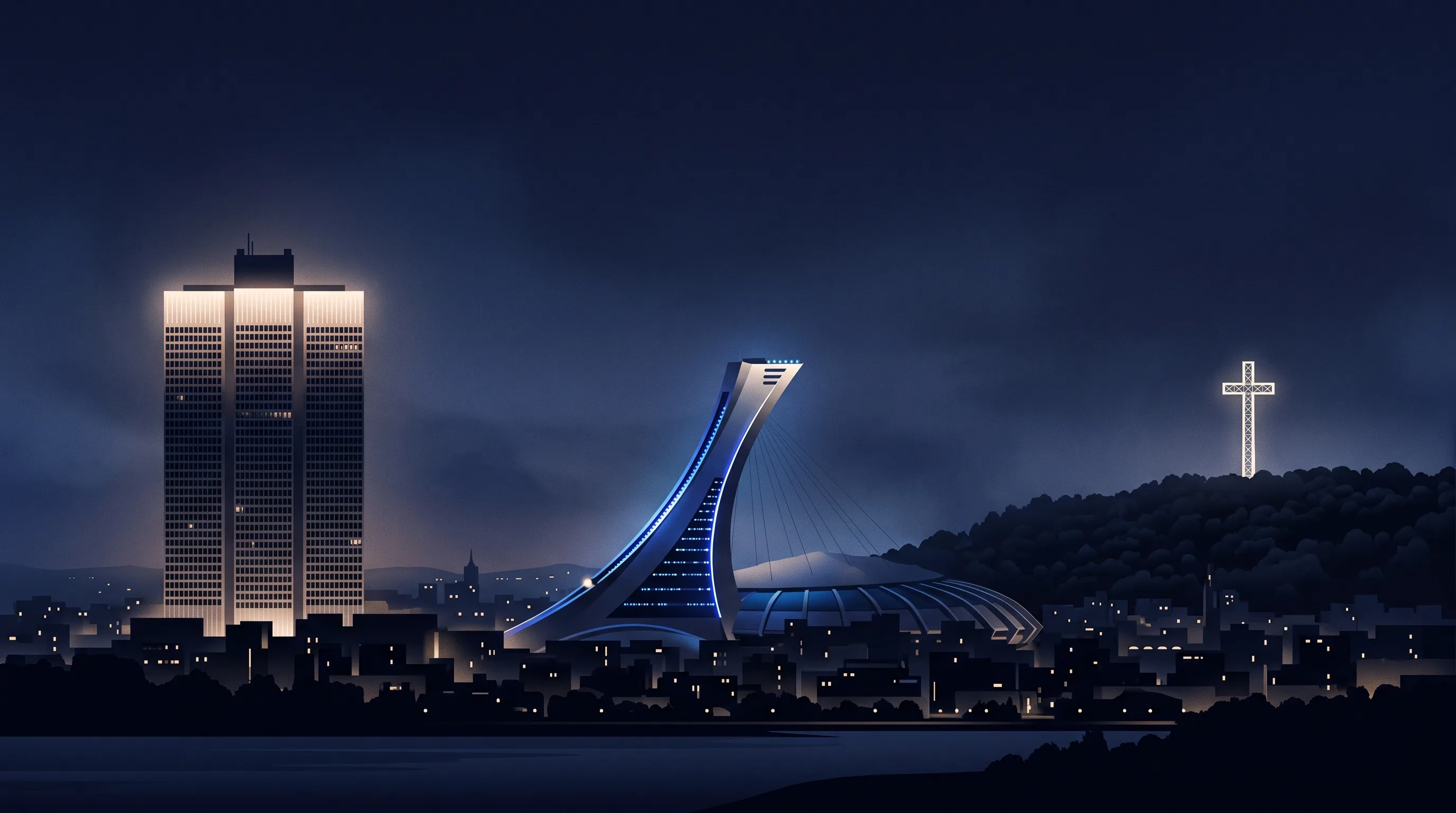
Technically yes — and that turns out to be the wrong question. Place Ville Marie, the Olympic Park Tower and the Mount Royal Cross have all, at some point, had a lighting system capable of changing colour. What separates them is not the hardware. It is what each one decided to do with it — and the three answers run from a permitted use, to a published policy, to an outright ban. All three answered differently, and the third one answered no.
Place Ville Marie: the colour lives in the soffit
The lighting design for the cruciform tower is credited to the firm Ombrages. Manufacturer Lumenpulse describes the installation on its project page: “The entire lighting design is achieved using more than 400 Lumencove Exterior Direct View and Lumenfacade luminaires, which are individually controlled to enable real-time lighting scenarios.” The same page lists the schedule: 224 Lumenfacade RGBW units and 224 Lumencove Exterior RGBW units, plus one lighting control system. (The page’s two language versions name different control products — a “Système de contrôle Pharos” in French, “Lumentouch” in English — so this post does not pick one.)
The two families do different jobs. The Lumenfacade luminaires “graze the building’s crown,” while the Lumencoves “project their light outwards in order to add the beacon-like prominence of the building.”
But the sentence a homeowner should notice is this one: “The addition of new colour-changing soffit lighting below the beacon enhances the building’s famed grandeur and allows the building to commemorate holidays, special occasions and the seasons.”
A soffit, colour-changing light, and a calendar of occasions. That is the logic of an exterior lighting line on a house, at a different scale. At Place Ville Marie, that sentence is the whole of what the source says: the manufacturer describes a permitted use. What the next two landmarks add is a written rule — one that says who may ask for a colour, and when.
The Olympic Park Tower: a programmed default, with permitted exceptions
In May 2014, the Parc olympique unveiled the second phase of the Tower’s exterior lighting, along its spine — the track the funicular climbs and descends. The overall concept is the work of two Montréal designers, Daniel Fortin and Gilles Arpin, and it followed a first phase completed in the Tower’s niche in the summer of 2013. A third phase, in the diadem at the summit, was described at the time as planned.
The spine installation uses “152 luminaires installed along the whole length of the Tower’s spine, the whole thing remotely controlled,” in the Parc olympique’s French wording. Claude Alarie of Éclairage Public described how far that control reaches: “We can decide the lighting sequence, the colours, the duration, the effects — in short, every possibility is open. The options are infinite.” The 60-watt luminaires announced at the time had “a service life of about twenty years” and were said to withstand “all weather, from intense heat to polar cold.”
Infinite options, then. And yet the general lighting policy the Parc olympique publishes today spells out what the Tower does with that freedom when it is lit: “Although the regular lighting at the Tower is blue and white to reflect Québec’s colours, the DEL lighting system in the Montréal Tower includes a wide range of colours with beams that can light with precision.” The exceptions run on a schedule: “An annual lighting schedule highlights national holidays, important events, and other significant dates using a range of coloured lights in the Tower.”
A regular colour, and a calendar for everything else. That is a complete rule in two sentences.
And the Tower goes further than the schedule: it publishes who is allowed to ask for a colour. Its “special thematic lighting policy is for non-profit organizations only, especially well-known foundations,” and it is blunt about the rest — “Any requests based on religion, ideology, or politics … will be refused,” as will “Any commercial requests (e.g. product launch, corporate event, etc.) or personal requests (e.g. marriage proposal, birthday, retirement, etc.).”
And it names who decides. A “request evaluation committee for special lighting” examines, the policy says, “the nature of the cause,” “the way the lighting will be used to highlight the cause/event,” “respect for the symbolism and integrity of the Montréal Tower and its link to the cause/event” and “the diversity of causes presented throughout the year.” Requests go in at least 60 days ahead, and a written answer follows “when possible, within 30 days.”
Hold on to that list — and to that committee. Together they are a written answer to a question the cross answered very differently.
Worth noting, too, that the Tower is unlit for now: “The lighting of the Montréal Tower is suspended until May 2027 due to renovation work in the tourist areas,” with the lighting request form deactivated until then. (The technical details above describe the project as announced in 2013 and 2014, not necessarily the equipment in place today. The two 2014 announcements are published in French only and are translated here; every quotation from the lighting policy in this section - the regular colour, the calendar, the eligibility rules, the evaluation committee and the suspension notice - is the operator’s own English.)
The Mount Royal Cross: the capability dates from 1992, the ban from 2010
Originally, according to the City of Montréal, “the 26-tonne steel structure was lit by 240 bulbs that traced its outline.” Changing the cross’s colour meant changing those bulbs by hand. The City is precise about what that cost: the 1992 replacement with a fibre-optic system “made it possible to change the colour of the illumination without having to manually change all the bulbs, which previously took two hours.” (The City publishes this page in French only, and Le Devoir, quoted later in this section, publishes in French; the quotations from both are translated here.)
Colour had just moved from manual labour to a command. And this is where the story stops resembling the other two: that new capability, the City writes, “was used twice” — once in purple on the death of John Paul II in 2005.
The system has in fact changed since: dark from 19 September 2008, the cross “was lit again on 4 February 2009 using an LED lighting system,” in the City’s words — and the City says nothing about what colour that system can produce.
Twice. Then, in May 2009, a working group of the Table de concertation du Mont-Royal was mandated to set guidelines, “in response to the numerous requests to temporarily change its illumination to mark an important event, a holiday or a particular demonstration.” On 12 May 2010 the City adopted “a resolution so that the lighting of the cross be white permanently and that at no time be a change of colour authorised to mark an event as had been done in the past.”
The reason the City gives has nothing to do with technology. It cites “the risk of trivialising the essential meaning of the cross through the multiplicity and heterogeneity of events,” and a wish to avoid “any drift, the arbitration difficulty that would come with it, and the inevitable dissatisfaction resulting from refusals.”
Put plainly: the problem was never producing the colour. The problem was deciding, every single time, whose event gets its colour — and saying no to the rest.
The cross is in fact under repair. Le Devoir reported on 3 June 2026 that the City’s executive committee had authorised “an expenditure of nearly 3.8 million dollars,” including a 3.1-million contract to Constructions ConCreate ltée, the sole bidder. Its lighting system is “at end of life,” and the contract covers “the replacement of the entire lighting system.” The lighting was switched off on Tuesday 29 September 2026 — CBC gave that date in a correction appended to its own report — the new system is to come into service in the autumn of 2027, and the worksite should finish in the spring of 2028. The same article recalls that when the cross was ceded to the City in 1929, it undertook “to maintain this monument in perpetuity not only in existence, but in good lighting condition.”
What the three rules have in common
Capability is not a decision.
All three have had a system capable of colour. What separates them is what each one settled on: at Place Ville Marie colour is a permitted use its manufacturer describes, the Tower holds a blue-and-white default with its exceptions written into a published policy, and the cross forbids colour permanently by the City resolution of 12 May 2010. Two of the three put it in writing. Not one of those three answers follows from the hardware that was installed. They are choices, and somebody settled each one once rather than case by case.
Two of them are dark tonight, as it happens. The cross “has gone dark, shut off for repairs,” as The Suburban put it on 9 October 2026, and the Tower’s lighting is suspended for its own renovation — until the autumn of 2027 in one case and May 2027 in the other. That says something simpler than any specification — architectural lighting is equipment, it reaches end of life, and it gets replaced.
So on a house, the question on installation day is not “can it do colour.” It is: what is lit every night, and what counts as the exception?
That is exactly the conversation the on-site visit is for. It runs about 40 minutes, it is free, and a good part of it is spent walking the property with you to discuss what you want lit every night — with a demo, then the whole-project quote walked through line by line, and the measurements at the end. The default gets decided there. Holiday scenes are the exception, not the other way round.
And the cross’s lesson holds for a house as much as for a mountain: the hard part is not producing the colour, it is deciding in advance when it comes out. A rule settled once saves you reopening the argument every December. If you want to see what a well-chosen default looks like, our projects are the clearest illustration.
Common questions
Is the Mount Royal Cross really always white?
White by rule, yes: on 12 May 2010 the City of Montréal adopted a resolution that its lighting be “white permanently,” with no colour change authorised to mark an event. Before that resolution the colour had been changed a handful of times, including purple on the death of John Paul II in 2005. Worth noting, though, that the rule governs the colour and not the continuity: the lighting was switched off on 29 September 2026 while the system is replaced, with a return announced for the autumn of 2027.
Why did the City ban colour on the cross?
Not for a technical reason. The City points to the risk of “trivialising the essential meaning of the cross” by multiplying events, and names “the arbitration difficulty” and “the inevitable dissatisfaction resulting from refusals.” It is a governance problem, not an equipment one. (The City publishes this page in French only; the quotations here are translated.)
Is the cross dark right now?
Yes. Its lighting was switched off on 29 September 2026 so that a system “at end of life” could be fully replaced — Le Devoir reported the executive committee’s decision on 3 June 2026, and The Suburban reported on 9 October that the cross “has gone dark, shut off for repairs.” The new system is announced for the autumn of 2027, with the worksite finishing in the spring of 2028.
Can house lighting really do what Place Ville Marie does?
The idea transfers; the scale does not. Lumenpulse’s project page describes colour-changing soffit lighting that allows the building to commemorate “holidays, special occasions and the seasons” — the same logic as a permanent line on a house: a default for everyday, scenes for the occasions.
Where do I start if I want to set my own default?
With the visit. It is free, runs about 40 minutes, and is mostly there to discuss what you want lit every night, with a demo to back it up, before the measurements and the whole-project quote.