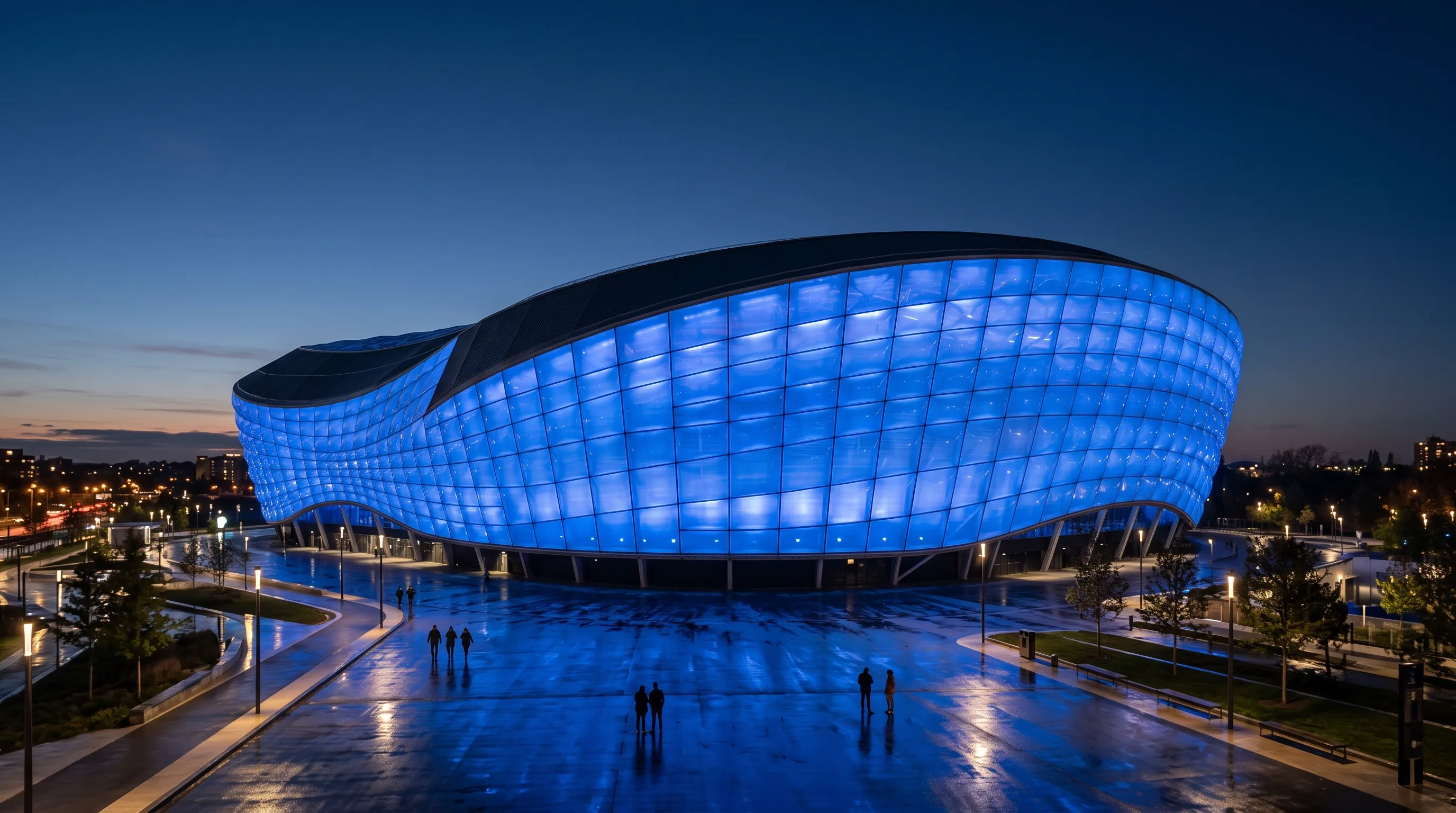
Four stadium facades built to be looked at after dark — Munich’s Allianz Arena, New York’s Madison Square Garden, Atlanta’s Mercedes-Benz Stadium and Beijing’s National Aquatics Center — share neither a shape nor a budget, but they all follow the same rule: the light source stays invisible and what you look at is the surface of the building. That is exactly the logic of a rail mounted under a soffit, at a different scale.
1. Allianz Arena, Munich — a whole envelope that changes colour
This is the benchmark: its operator calls it Germany’s first and Europe’s largest stadium with LED exterior lighting running right around the building. The skin is made of 2,784 diamond-shaped ETFE cushions, held inflated by fans at a constant 350 pascals, covering 66,500 square metres of roof and facade. Until 2015, that skin could only display three colours: white, red and blue.
The current installation, delivered by Philips in August 2015, uses 6,500 linear luminaires and more than 300,000 LEDs to light 26,000 square metres of facade in 16 million colours. It can refresh an image up to 40 times per second and is built to operate down to −50 °C. Switching to LED cut the facade’s lighting consumption by about 60%.
The lesson: one hue held across an entire envelope reads far stronger than ten colours competing for attention. A whole building in red is legible from kilometres away; the same building in rainbow is legible from nowhere.
2. Madison Square Garden, New York — the source hidden in a cove
The Garden is cylindrical, and you never see its exterior lighting directly. The fixtures sit inside horizontal cove channels and the roof ring: 1,952 LED fixtures across more than a mile of cumulative run on the building exterior, commissioned in October 2014 at the end of a three-year renovation. The design is credited to Al Borden of The Lighting Practice — the same designer associated with the Empire State Building tower lighting.
The detail that matters: the beams were chosen tight, to light the surface rather than the sky. From the street the building reads as a stack of glowing bands that take on the colours of whichever team is playing.
The lesson: this is word for word the principle of a soffit. You don’t see the fixture, you see the facade. A well-aimed cove does work no floodlight staked in the lawn will ever do.
3. Mercedes-Benz Stadium, Atlanta — when the material decides the result
Opened in August 2017 and designed by HOK, the Atlanta stadium alternates insulated metal panels with sections of transparent ETFE, including an opening of roughly sixteen storeys that frames the downtown skyline. The eight moveable roof “petals” are lit, per the fixture maker’s project sheet, by 120 W, IP66-rated LED fixtures. It was the first professional sports stadium in North America to earn LEED Platinum certification.
The result: depending which section you look at, the same building reads as opaque and metallic or as translucent and luminous. Nothing was added to create that effect — the material simply responds differently to light.
The lesson: before choosing an intensity, look at what the light is going to land on. Dark brick, pale stucco and metal cladding return wildly different amounts of light. It’s one of the reasons we measure and run a demo on site instead of selling a wattage over the phone.
4. Beijing National Aquatics Center — lighting from the inside
The “Water Cube,” designed by PTW Architects with Arup for the 2008 Games, is wrapped in roughly 4,000 ETFE cushions of varying sizes, some as large as nine metres across according to Arup’s structural engineer on the project. The LEDs sit behind those cushions: the light passes through the membrane instead of striking a surface. At night the building becomes a block of translucent blue bubbles.
The lesson: diffusion often beats power. Light travelling through a translucent material creates no hot spot and no glare. At the scale of a house, that’s the same reasoning behind lighting a cove or a window surround.
What all four have in common
Four buildings, three continents, and yet the same four decisions:
- The source is hidden, the surface is lit. Never the other way around.
- One scene at a time, driven by a controller and a schedule — not a switch.
- Hardware specified for the climate. The Allianz Arena is rated to −50 °C because Munich freezes. Our LEDs are IP68-rated and tested at −40 °C, with a lifespan of 50,000 hours and up, for the same reason.
- Light aimed at the building, not at the sky — the wording Québec’s own municipal-planning guide gives municipalities for a nuisance bylaw: never toward the sky, every source pointed down.
At residential scale that becomes a continuous rail on the roofline, warm white most evenings, colour a handful of nights a year. It’s the basis of how we approach exterior lighting, and it’s also why one system covers holiday lighting without anything being reinstalled. To check whether your municipality is on our route, the list lives on the service area page.
Common questions
Which stadium has the best lit facade in the world? There’s no official ranking. Start with Munich’s Allianz Arena: its operator calls it Germany’s first and Europe’s largest stadium with LED exterior lighting running right around the building, and its ETFE skin lights up in 16 million colours across 26,000 square metres — the part of the envelope you see from the street.
Are stadium systems anything like a residential system? The scale isn’t comparable, but the underlying technology is the same family: addressable LEDs, a controller, programmed scenes. What differs is the number of points and the distance from which the building is read.
Why hide the fixtures instead of showing them? Because a visible fixture becomes a glare point that flattens the facade. Tucked into a cove or under a soffit it disappears, and all you perceive is the lit surface — a much cleaner result, and a better one for the neighbours.
Does this kind of lighting hold up to a Quebec winter? Yes, if the hardware is chosen for it. Our LEDs are IP68-rated and tested at −40 °C; controllers and pixels carry a 12-year warranty, light bars and landscape fixtures 3 years, with 3 years of labour.
What does a residential project like this cost? It depends on the scope. For a home, a Starter project runs around $3,000–5,000, a Standard project around $5,000–15,000, and a Complete project starts at $20,000+ — often beyond $50,000 — covering exterior, interior and backyard.