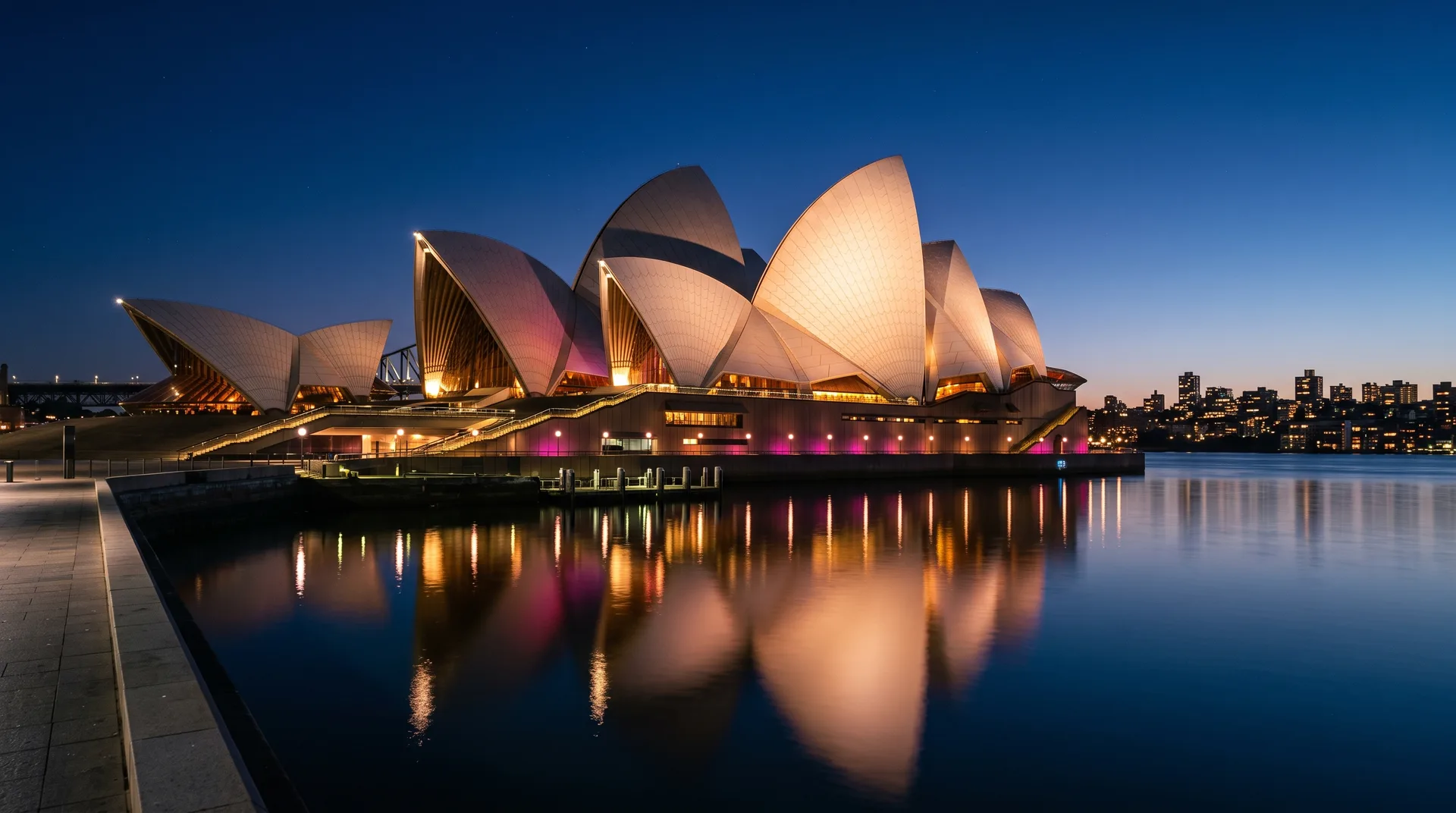
Both, and not interchangeably. The Sydney Opera House publishes a policy on illuminating its sails, and where an outside organisation asks for colour, that policy allows two methods: the flood lights belonging to the building itself, or projection equipment set up outside the site. Either way, what a third party may ask for is one static colour. Images and patterns the venue keeps, as a general rule, for its own presentations. Which means the building’s own operator has already settled, in writing, the same question a homeowner stands in the driveway asking — does the light get installed on the building, or thrown at it? — and its answer is that these are not two versions of the same move.
The building was designed by Danish architect Jørn Utzon and opened its doors in 1973. The venue describes it as “this World Heritage-listed masterpiece.”
A surface designed to receive light
Before the method, the surface. The Opera House shells are not painted — they are tiled, and the count is exact. According to the Opera House itself, “there are 1,056,006 tiles on the roof.”
That tile was developed for the job. “Three years of work by Höganäs of Sweden produced the effect Utzon wanted in what became known as the Sydney Tile, 120mm square, made from clay with a small percentage of crushed stone.”
The design criterion behind it is a lighting lesson in a single line. The Opera House writes that the “tiles needed to be gloss but not be so mirror-like to cause glare.”
Glossy, but not a mirror. That is exactly the compromise you are looking for on a house facade, at a different scale: too matte a surface swallows light, too reflective a surface throws it back into your eyes instead of revealing the shape. In his Design Principles, published in 2002, Utzon returned to the tile choice and remarked that they “were a major item in the building. It is important that such a large, white sculpture in the harbour setting catches and mirrors the sky with all its varied lights dawn to dusk, day to day, throughout the year.”
Hold on to the logic: the surface is part of the lighting system. It is not the backdrop, it is the instrument. A house works the same way — stone, brick, stucco and aluminium do not return the same light, which is why the materials get looked at before anyone talks about fixtures.
Two methods, and a policy that separates them
The document is the Illumination of Sydney Opera Sails Policy (SOH104, version 2.2, effective 3 May 2012 — the version the Opera House publishes on its own site). It governs “applications by third party organisations to light the Sydney Opera House Sails.”
Clause 3.8 is the one to read. Third-party designs are limited to static single colour illumination, “using either: the flood lights on the western side of the building; or high quality projection equipment located outside the Sydney Opera House site.”
There is the fork, drawn by the building’s own owner. On one side, equipment that belongs to the building: when a third-party request is approved, “coloured lighting will be provided by Sydney Opera House,” with equipment and labour charged back to the applicant. On the other, projectors standing somewhere else and aimed at the sails.
And the two methods do not buy the same thing. Third-party illumination is capped: “Lighting of the Sails by third party organisations will be permitted no more than 8 times per year and is limited to static single colour illumination only.” Eight times a year, one colour, static. Images and patterns are kept in-house — “as a general rule,” the text says, leaving the Chief Executive Officer an exception in “exceptional circumstances”: “As a general rule, projections of images and patterns will be reserved for Sydney Opera House in order to maintain the unique nature and artistic value of those Sydney Opera House presentations that incorporate lighting of the Sails.” Logos get the same treatment — “No logo or corporate identity shall be permitted to be projected onto the Sails.”
A flat colour wash is equipment. An image is a production. The policy treats them differently because they are not the same act.
What the Opera House keeps for itself: projected shows
The venue’s signature programmes are projection, and the eight-occasion cap is not aimed at them in the first place: the policy governs “applications by third party organisations,” and the cap it sets is on “Lighting of the Sails by third party organisations.” The policy adds that the limit “does not apply to lighting or projections onto the Sails conducted in association with major Sydney Opera House events.”
The first is nightly. Badu Gili “is a free nightly experience that explores First Nations stories in a spectacular six-minute projection on the Opera House’s eastern Bennelong sails.” The name is about light itself: Badu Gili means “‘water light’ in the language of the traditional owners of Bennelong Point, the Gadigal.” The Opera House states that the work “will light the eastern Bennelong sails nightly from sunset all year round, unless otherwise advised.”
The second is annual. Vivid Sydney’s Lighting of the Sails page describes the principle this way: “Each year an internationally-renowned artist is commissioned to create an original artwork for projection onto the Sydney Opera House.” One note for honesty’s sake: the event data on that page covers the 2022 edition, so the sentence describes how the festival frames the commission rather than what is happening this year.
Look at what the two programmes share. There is content commissioned from somebody. There is a schedule published by an institution. There is a run time — six minutes, and then it is over. It is a performance, with the staffing and the calendar that implies, and that “unless otherwise advised” says the rest.
Montreal does the same thing, on its own walls
You do not need to fly to Australia to watch this logic work. Cité Mémoire, in Montreal, projects tableaux onto the city itself, and its producers describe an artwork that emerges from the walls, the ground and the trees around the viewer. The nighttime tableaux were created by Michel Lemieux and Victor Pilon, with texts and dramaturgy by Michel Marc Bouchard.
The schedule looks a lot like Sydney’s: “Starting May 17, 2026, 9 scenes from Old Montreal will once again be projected from Wednesday through Sunday, as soon as night falls.” Nine scenes, five evenings out of seven, after dark. That is an event with a calendar.
None of which is a criticism — it is beautiful, and it is the right tool for telling a story. But it is an event tool. Wednesday through Sunday means that on Monday, the wall is a wall.
What this changes for a house
Clause 3.8’s question is exactly yours at a different scale: does the light belong to the building, or does it get sent at it? Permanent architectural lighting picks the first answer, and its strengths are the ones projection does not have.
It is attached to the architecture. The fixtures follow the building’s lines — the roofline, the soffit, the peaks, the columns — and the building draws the result. Nothing sits fifty metres away, nothing depends on a clear throw angle, and nobody walks a generator across the yard.
It runs with no operator. That is probably the real difference. A projected show needs someone to programme the evening; an installed system comes on by schedule and keeps that schedule every night, Mondays included. On a house, that is what replaces an institution’s technical staff: a programme, not a crew.
It lives outdoors year-round. An event projector gets packed away after the show. An installed system spends the winter on the facade — which is why the warranty reads by part: 12 years on controllers and pixels, 3 years on light bars and landscape lighting, and 3 years on labour.
So what transfers from Sydney is not the equipment — it is the method. You look at the surface first: its colour, its finish, its ability to catch light without glaring, which is precisely Utzon’s tile criterion. Then you decide what the building should do every night, by default. And you keep the special scenes for the occasions instead of making them the everyday. That is the conversation we have on site when we plan a line of exterior lighting on your home, anywhere in our service area.
Common questions
Does the colour on the sails come from lights installed on the building, or from projectors?
Both exist, and the Opera House’s policy names them separately: for a third-party request, “the flood lights on the western side of the building” or “high quality projection equipment located outside the Sydney Opera House site.” The same policy elsewhere refers to “the flood lights on the Sails” being turned off for an occasion of significance. The venue’s own signature programmes, such as Badu Gili, are described as projections.
Why only one static colour for third-party requests?
Because the policy says so, and the cap comes with it: no more than eight times a year, “limited to static single colour illumination only.” Projections of images and patterns are, “as a general rule,” reserved for the Opera House itself — the policy leaves the Chief Executive Officer an exception in “exceptional circumstances” — and no logo may be projected onto the sails. That is a governance rule, not a technical limit.
What replaces the operator on a house?
The schedule. An institution has staff who launch a show at a set time; a house has a programme that runs itself every evening. That is why so much of the conversation is about what you want lit every night — that is the default, and it is the thing working every evening of the year.
What does a permanent lighting project cost?
It is priced as a whole project, never by the foot. A starter project runs around $3,000 to $5,000. A standard project goes from $5,000 to $15,000. A complete project starts around $20,000 and up, and often goes past $50,000 once you combine exterior, interior and the backyard.
How does the visit work?
It is free and takes about 40 minutes. We walk the property with you, talk through what you want lit every night, run a demo so you can see what you are booking, go through the whole-project quote line by line, then measure the rooflines, levels and soffits — a boxed soffit and an open eave do not take the same rails. If you sign the agreement on the spot, a 30% residential deposit applies at signing.