Almost never on the landmark itself. The operator’s own list of where the Niagara Falls fixtures are housed names three places, and none of the three is the waterfall: “Special lights are housed in the Illumination Tower, next to Queen Victoria Place; on the roof of Table Rock Centre, at the brink of the Horseshoe Falls; and deep in the Niagara Gorge, across from the American Falls.” Look closely at three landmarks and you get three different answers to the same question — and each answer is forced by a different constraint: what can physically carry a fixture, what someone has to climb to service it, and what the beam must not spill onto.
It is also the first decision on a house, long before anyone picks a colour.
Niagara Falls: when there is nothing to mount a fixture on
A waterfall has nothing to bolt a fixture to, and the published arrangement reflects that: a fully remote system spread across three positions — the Illumination Tower beside Queen Victoria Place, the roof of Table Rock Centre at the brink of the Horseshoe Falls, and the Niagara Gorge, across from the American Falls.
That last position is the telling one: to light the American Falls, the fixtures stand on the other side of the gorge. When the lighting has to stand somewhere other than its subject, somebody else owns the ground it stands on — and that eventually shows up in the structure that runs it. The “Illumination of the Falls” has been “financed and operated by The Niagara Falls Illumination Board since 1925,” a binational board whose 100th anniversary was marked in 2025 and which brings together six public agencies from two countries: the cities of Niagara Falls in Ontario and in New York State, Ontario Power Generation, the New York Power Authority, the New York State Office of Parks, Recreation and Historic Preservation, and The Niagara Parks Commission.
The equipment was last modernised in 2016: “In 2016, almost 20 years since the last major investment in falls lighting, the existing Xenon lights were replaced with new, energy-efficient LED lighting technology. These new lights provide more than twice the previous lighting levels, programmable lighting, and a wider spectrum of colour.” The schedule follows the seasons rather than the clock — the lights come on at 5 p.m. in January and at 8:30 p.m. from 15 May.
The Statue of Liberty: the real question is how you get back up there
On the statue, the torch’s light genuinely is on the torch. The National Park Service puts it this way: “The Statue’s current replacement torch, added in 1986, is a copper flame covered in 24K gold. It is reflective of the sun’s rays in the daytime and lit by 16 LED floodlights at night.”
And it is the next sentence that matters: “National Park Service staff must climb a narrow 40ft. ladder in order to maintain the floodlights that light the torch.” Sixteen fixtures, and a 40-foot ladder every time somebody has to reach them. Placing a fixture is also deciding what its upkeep will demand for the next twenty years. That is the same arithmetic a house runs when it chooses between something hung up temporarily and a system installed once — and the reason the hardware in our exterior lighting is rated IP68 and tested to −40 °C, with a rated life of 50,000 hours and more, roughly 15 to 23 years of normal use.
The CN Tower: what the beam must not spill onto
Here the structure carries its own system. The English page says “The CN Tower installed an intelligent LED illumination system that is energy efficient, cost efficient and provides a number of added unique benefits” — and the Tower’s French page is more explicit still, describing the system as “installé sur la Tour CN,” installed on the Tower itself. Each fixture is “microprocessor-controlled” and “can produce 16.7 million colours,” while “intelligent digital control makes the system programmable from a single computer console,” every fixture having “a unique ‘address’ that can be programmed individually.”
But the thing the Tower leads with is not colour. It is aim: “Unlike conventional light sources, one of the unique benefits of LEDs is that they are directional. This means that the lights’ output can be controlled and precisely directed to illuminate the Tower while ensuring light output does not ‘spill’ or interfere with nearby hotels, office towers or residences.” In a dense downtown, in other words, the governing constraint is not lighting the tower — it is lighting only the tower.
Two more details on the same page are worth the detour. The LEDs “radiate little to no heat” and “do not emit ultraviolet (UV) radiation or infrared (IR), which makes them ideal for illuminating areas at the Tower without affecting the radome and other sensitive areas” — so fixture position is partly a question of what sits right beside it. And the schedule is humbler than you would expect: “The lights turn on at sunset, but typically aren’t visible for 30 minutes until the sky is dark enough.”
The same three constraints on a house
None of these three operators has published a method, and these are not three official steps. They are three observed arrangements — but the three constraints they illustrate turn up unchanged on a Montreal house.
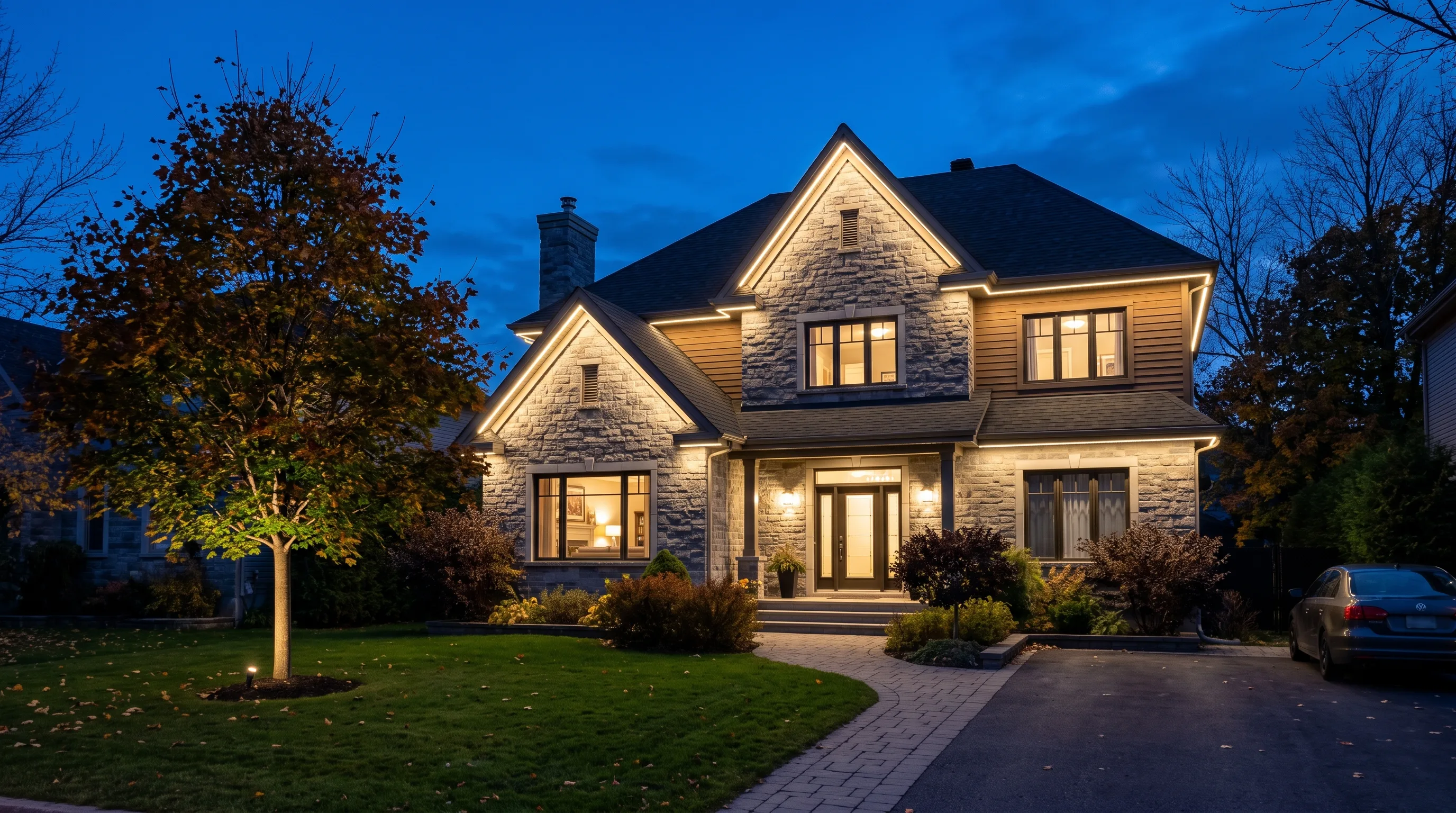
What can carry a fixture? A house, unlike a waterfall, can carry its own: that is why a permanent system mounts along the rooflines and soffits. Whatever can carry nothing — a tree, a low wall, a planting bed — takes fixtures at ground level instead, which is the business of landscape lighting. During the visit we measure the rooflines, the levels and the soffits, because a boxed soffit and an open eave do not take the same rail.
What will somebody have to climb later? That is the torch’s constraint, and it is settled at purchase rather than at maintenance time: our controllers and pixels carry a 12-year warranty, light bars and landscape fixtures 3 years, with labour covered for 3 years.
Where will the light land besides the house? That is the CN Tower’s question, and it is the one raised during the free visit of about 40 minutes: we walk the property with you, talk through what you want lit every night, show you a demo, then present the whole-project quote line by line. The warranty and deposit details also live in our FAQ.
Common questions
Where are the lights that light up Niagara Falls? In three separate places, according to Niagara Parks: the Illumination Tower next to Queen Victoria Place, the roof of Table Rock Centre at the brink of the Horseshoe Falls, and the Niagara Gorge, across from the American Falls.
Who decides what colour Niagara Falls is? The “Illumination of the Falls” has been financed and operated since 1925 by The Niagara Falls Illumination Board, a binational board made up of six Canadian and American public agencies.
How many floodlights light the Statue of Liberty’s torch? Sixteen LED floodlights, according to the National Park Service. The current torch was added in 1986, and staff must climb a narrow 40 ft. ladder to maintain them.
Does permanent lighting bother the neighbours? That is exactly the constraint the CN Tower leads with: its LEDs are directional so they light the tower without spilling onto the buildings around it. On a house it is a question to raise at the visit, when you decide together what gets lit every night.
Do the CN Tower’s 16.7 million colours apply to a house? That figure belongs to the CN Tower’s own fixtures and is published by the Tower itself; it describes no Vision Bleu product. What carries over from a landmark to a house is the set of position constraints — carry, reach, spill — not the equipment specifications.