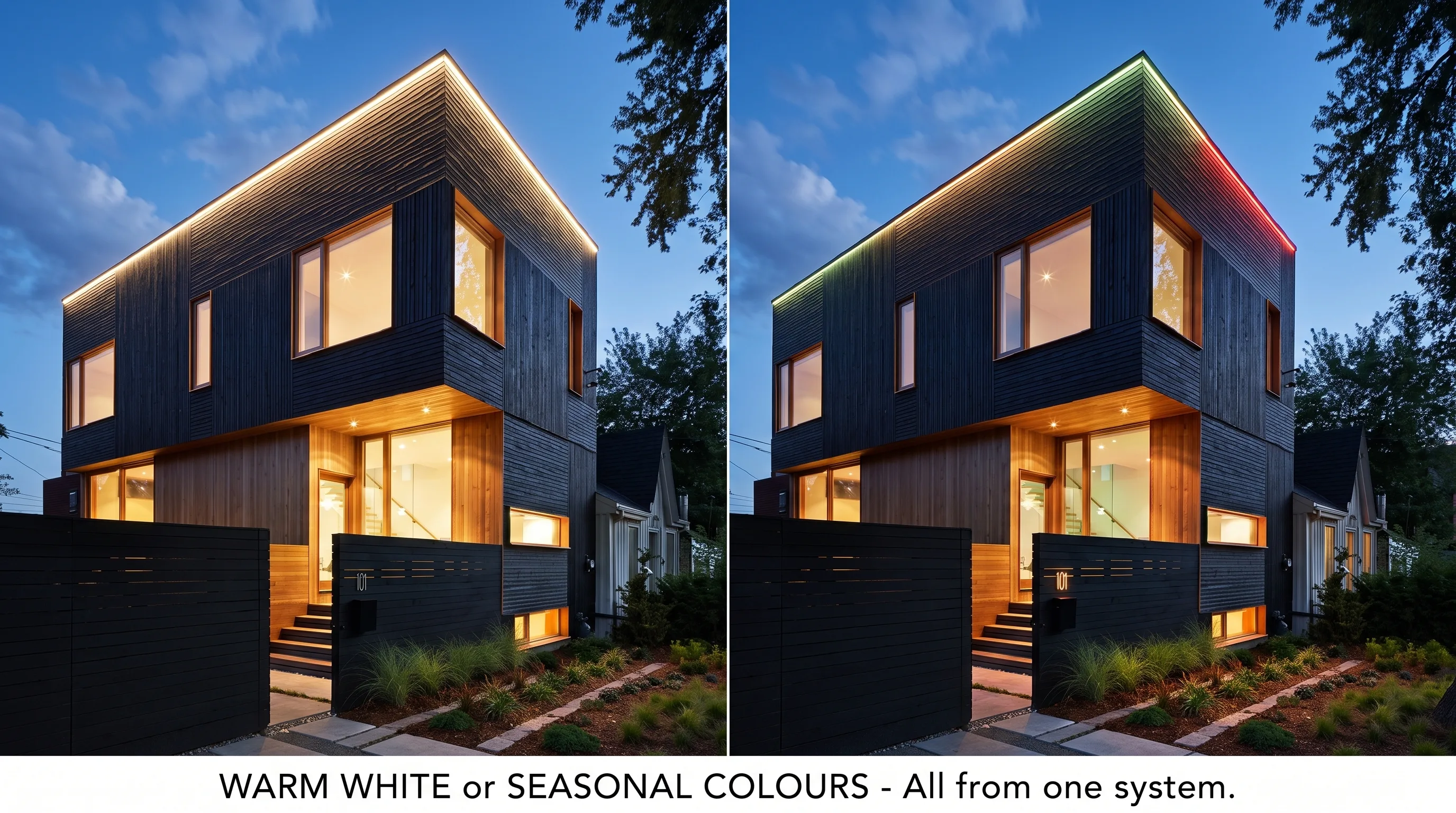
Warm white is the setting you will use almost every night, and colour is the one you will use a handful of nights a year. The system does both because it is the same rail and the same controller — the 16 million colours are not an upgrade, they are already there. If you are buying permanent lighting for the colour, you are buying a system you will run in warm white most of the year.
Quick reference
- Warm white — the everyday scene. On at sunset, off late, or held very low overnight.
- Cool white — reads better on grey stone and in winter than it does on wood siding.
- Colour — Christmas, Halloween, a birthday, a game night, Saint-Jean.
- RGB-WW — red, green, blue plus a dedicated warm-white chip. The white is not mixed out of the other three.
- Dimming — light bars dim 1 to 100% per zone, with no visible flicker at low levels.
Why warm white wins on an ordinary Tuesday
Warm white is the colour temperature residential lighting guides point you at. Natural Resources Canada’s Home Lighting Design Guide Pocket Book puts it plainly: “Lamp choices should be 2700-3000K to create a warm, inviting and relaxing atmosphere.” The only room it sends cooler is a home office, where it suggests 3500K.
The same guide gives you the whole scale in one line: “the higher the Kelvin number, the cooler the light source.” That is all the theory anyone needs. 2700K leans golden, 4000K reads crisp, and neither number tells you anything about how bright the light is.
Something we say at every visit: pick your white on your own house, at dusk, not on a screen. The same warm white looks more golden on wood siding and more neutral on grey stone, because the material decides as much as the setting does.
Where the 16 million comes from
Every addressable pixel carries three channels — red, green, blue — at 8 bits each. 256 × 256 × 256 is 16,777,216 combinations. That is the whole derivation, and it is the same arithmetic in any standard 8-bit pixel system.
The fourth channel matters more. Our exterior systems are RGB-WW: warm white has its own chip instead of being built by adding red, green and blue together. That is the difference between a white that looks like white and a white that goes faintly lilac across a pale stone facade.
Not every facade gets pixels. Depending on the project we install light bars or an addressable pixel rail, and only the pixel rail gives you different colours along the same run. A light bar does not do colour at all: it runs warm white through cool white, with dimming. The exterior lighting page shows both.
What you will actually programme
Most clients keep warm white year-round and change it a few times: red and green in December, blue and white on June 24, orange at Halloween, team colours on a game night. It is the same hardware as our holiday lighting — nothing to add, nothing to put away in April.
The schedule does more work than the colour does. Sunset on, full until 11 p.m., then very low for the rest of the night. A facade held low is still a facade that reads as occupied, and that is the setting people keep once they have tried it.
The honest limit
Colour is spectacular for thirty seconds and ordinary after a week. If the picture in your head is a purple house every night, you will get tired of it before we do. The real case for permanent lighting is warm white under the roof edge, 365 nights a year — colour is the bonus that retires the December ladder.
There is a second limit worth knowing. Inside the house we always fit light bars, never pixels, because the white quality and the fine dimming matter more in a room you sit in. A kitchen or a bedroom will not do rainbows, and in five hundred–plus residential installs nobody has asked it to.
Common questions
Does colour cost more than white? No. On a pixel facade it is the same rail, the same controller and the same install: you are not paying extra for colour and you cannot remove it to save money. A light-bar facade is a different product, and a different price — colour is not part of what it does.
Can I run warm white in front and colour in the back? Yes. Zones are set independently, for colour and for brightness. Plenty of clients keep the street-facing facade in warm white and use colour in the backyard or on the landscape lighting.
Does colour use more power? Not in any way you would notice. The residential controller is capped at 450W for the entire system at full brightness with every zone on — a ceiling a mid-brightness warm-white scene never comes close to.
What if a pixel shifts colour after a few years? Controllers and pixels carry a 12-year warranty, light bars 3. Labour is a separate 3-year warranty: inside that window the visit costs nothing, and after it the part stays covered while the visit is billed at the hourly rate in force at that time.