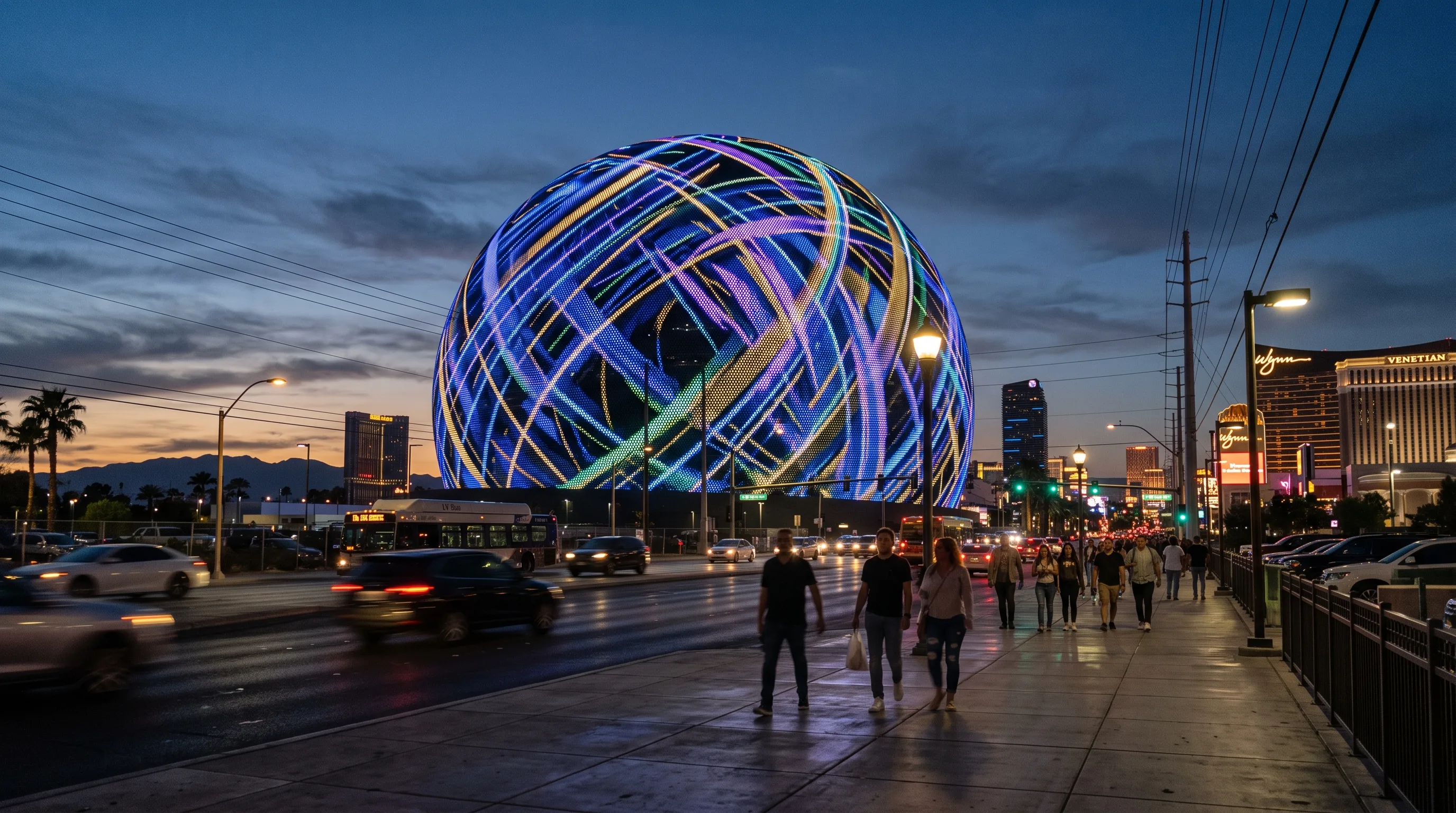
The largest LED facade on Earth covers an entire building in Las Vegas with 54,000 square metres of light points, and it runs on a principle your house already uses: individually addressable pixels that can be turned on and controlled one at a time. Behind the Sphere’s spectacle is a lesson in density and control that maps directly onto the rail we mount under a Montreal soffit.
What the Sphere actually is
The Sphere opened on September 29, 2023, and cost roughly US$2.3 billion — the most expensive entertainment venue ever built in the Las Vegas region. The building, 366 feet tall, is completely wrapped in LED: 580,000 square feet of visible surface, about 54,000 square metres, the largest video screen in the world. Inside, another membrane envelops the hall — 17,385 seats, by the operator’s own count — in a 16K image that surrounds the audience.
And the screen itself is Montréal work. Sphere Studios “partnered with Montreal-based SACO Technologies… to design and manufacture the Exosphere’s unique LED display,” in the operator’s own words. The largest LED screen on Earth was engineered here.
The thing to take away is not the size. It’s that every single point can be driven independently — and that independence is exactly what lets the facade hold a blinking eye or an entire firework display on a curved surface without anything “breaking” where the building turns.
Lesson one: pixel density
A screen is only legible up close if the gap between two points is smaller than the eye can resolve at that distance. The same grid turns into mush if you stand too close. On the Sphere, the points sit eight inches apart — approximately 1.2 million LED pucks, per Sphere Entertainment’s own figure. Nobody has published why that pitch and not another, but do the arithmetic yourself: eight inches vanishes at the distance the Strip reads it from, and it would look like a field of dots from across the street.
The same arithmetic holds at the scale of a house. Under a soffit, what you look at from your front door or the sidewalk isn’t a screen — it’s a line of points along the roofline. The question isn’t “how many pixels,” it’s “how far does the viewer stand from the building.” A rail whose grid is matched to the reading distance of a facade does the job without wasting energy or budget — the opposite of a needlessly dense wall of points.
Lesson two: control, not power
The expensive part of these installations is almost never raw brightness. It’s control: the ability to address each point, swap scenes in a second, program a cycle from sunset to dawn. At the Sphere, operators don’t “dim a fixture”; they compose an animation on a calendar, like a programme rather than a switch.
At home it’s the same shift in mindset. A permanent system isn’t a string of lights plugged in in November and unplugged in January. It’s a controller holding scenes — warm white most of the time, colour a handful of nights a year — and a schedule that decides what comes on when. The same rail handles everyday, holiday and overnight lighting without anyone touching it. That’s why, on our exterior lighting page, we talk more about scenes and schedules than about watts.
Lesson three: where the Sphere is the wrong model
Here the comparison stops, and that’s the point. The Sphere is a screen — a surface built to be looked at, radiating outward in every direction, including straight up. It has never pretended otherwise: the Las Vegas Review-Journal called it “the biggest and brightest sphere on the planet,” and in the same piece the vice-president of the Las Vegas Astronomical Society said light pollution is a big problem in the valley and that the sphere isn’t quite helping.
A roofline rail does the opposite job. It isn’t there to be looked at — it’s there to make the building visible. Light travels down across the facade, follows the roofline, and stays off the neighbour’s property and out of the sky. That’s the geometry Québec towns ask for where they regulate outdoor lighting at all: Hudson’s règlement 617, adopted in 2012, requires fixtures aimed “seulement l’endroit voulu vers le bas” — lighting only where it is wanted, pointed down — and bans anything aimed up at the sky outright. If you’ve wondered how a facade stays crisp without creating light pollution, the answer lives in orientation: you light the building, not the atmosphere.
What it carries down to your house
Nobody installs 54,000 square metres of LED on a home. But the three ideas hold at residential scale: a grid matched to reading distance, a controller that programs scenes instead of a switch, and — where the Sphere goes the other way — light aimed at the facade rather than the sky. That’s exactly what we design on site, from holiday lighting to the roof edge itself.
For the rest — maintenance, warranty, what’s actually covered — the common answers live on the FAQ page.
Common questions
Is the Sphere really the world’s biggest screen? Sphere Entertainment publishes 580,000 sq ft of LEDs on the exterior — about 54,000 square metres, the largest video screen in the world. The venue also cost roughly US$2.3 billion, making it the most expensive entertainment venue in the Las Vegas region.
Is more pixels always better? Not automatically. Pixel density has to match the viewing distance. A screen seen from far away doesn’t need extremely tight points; a facade viewed up close does. The same logic informs the pixel grid of a soffit rail.
Can a permanent home system really change scenes? Yes. That’s the controller’s job: programmed scenes (warm white most evenings, colour for holidays) and a schedule that runs them. The hardware stays the same all year.
Is residential lighting expensive? It depends on the scope. For a residence we talk about a Starter project starting around $3,000–5,000, a Standard project around $5,000–15,000, and a Complete project of $20,000+ — often beyond $50,000 — covering exterior, interior and backyard.