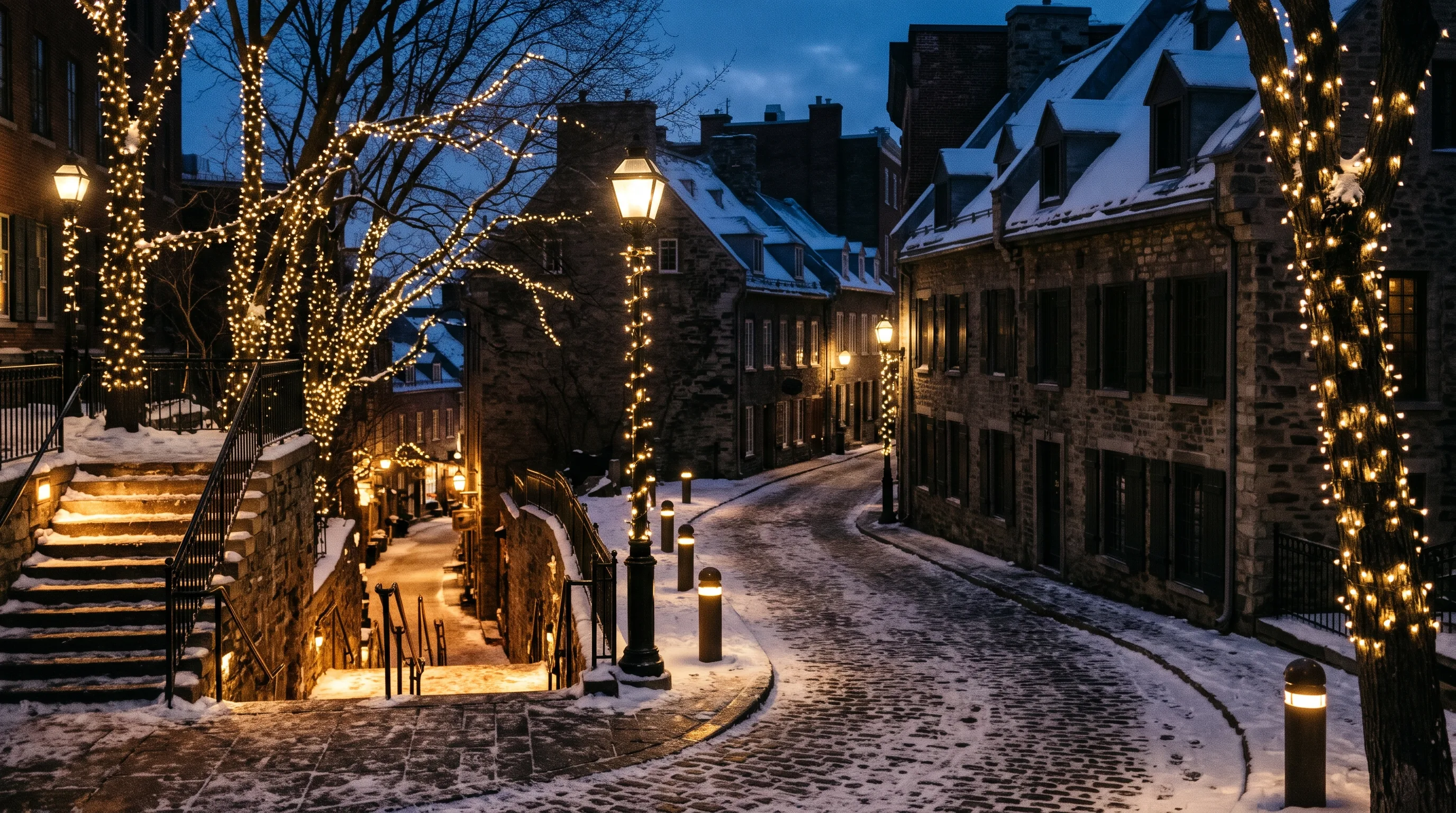
On Old Québec’s winter light route, the one edition with a published element-by-element inventory put most of its anchor points on the street itself rather than on buildings. In that inventory, for the first edition, the lights were installed on “cinq bâtiments patrimoniaux ou architecturaux, dans trois escaliers, sur 26 lampadaires et dans 68 arbres” — five heritage or architectural buildings, three staircases, 26 lampposts and 68 trees — plus “huit lanternes murales et 27 structures sur bollards spécialement construites pour l’occasion”: eight wall lanterns and 27 purpose-built bollard structures. Five buildings, then, against 124 anchor points at sidewalk level.
That ratio is the interesting part. It describes a route hung on the things a pedestrian walks past — trees, lampposts, staircases, bollards — rather than a district lit by aiming floodlights at facades.
One caveat, and the post keeps it in view: the balance is published only for that first edition. The only element of the second edition with a published count was a wall — a 30,000-light cascade, out of nearly 100,000 lights on the route. So this is a description of one winter’s inventory, not a rule the route follows every year.
A note on sourcing before we go further: both of the producers’ releases are published in French only, so the quotes below are given in the original with our translation beside them.
The published inventory, 2025 edition
The first edition’s release describes a 1.2-kilometre circuit, “de la porte Saint-Jean jusqu’à la rue du Sault-au-Matelot” — from the Saint-Jean gate to rue du Sault-au-Matelot — carrying “75 000 lumières et 1 000 lanternes”, 75,000 lights and 1,000 lanterns. It was mounted by the team behind Québec’s German Christmas Market, with Artefact Urbain, who “a fait en sorte que ces quartiers soient gais et attrayants tout l’hiver”: made these districts cheerful and attractive all winter.
That release is the only one of the two that publishes a breakdown by element type. This is why the numbers above describe the 2025 edition specifically, and not the route in general.
Two features are named as worth seeing in their own right: “L’escalier Frontenac qui brille de mille feux et le passage du Roi, qui mène au Petit Champlain” — the Frontenac staircase and the passage du Roi leading down to Petit Champlain. A staircase and a passageway: two places you walk through, not two walls you look at from across the water.
What the second edition changed
The route came back the following winter “pour une deuxième année”, for a second year, and it was re-specified. The January 2026 release announces “près de 100 000 lumières et 1000 lanternes” — nearly 100,000 lights and 1,000 lanterns — on a path that “s’étend sur un peu plus d’un kilomètre, entre la rue Saint-Jean et la rue du Sault-au-Matelot”: a little over one kilometre, between rue Saint-Jean and rue du Sault-au-Matelot. The lights are described as going “sur les portes St-Jean et Prescott, dans les arbres, les lampadaires et dans l’escalier Frontenac” — on the Saint-Jean and Prescott gates, in the trees, the lampposts and the Frontenac staircase.
New pieces appear: “Des arches ont été installées rues Saint-Louis et du Sault-au-Matelot de même qu’une chute de lumières sur le mur arrière de l’hôtel 71.” Arches on rue Saint-Louis and rue du Sault-au-Matelot, and a cascade of lights down the rear wall of Hôtel 71. That cascade alone holds 30,000 lights and, in the release’s words, “crée un lien visuel entre le Vieux-Québec et le Vieux-Port” — creates a visual link between Old Québec and the Old Port.
The rhythm changed too. In 2026, “les couleurs et l’ambiance du parcours changeront six fois d’ici la mi-mars”: the colours and mood would change six times before mid-March. The 2025 release instead said the mood would change “quelques fois” — a few times — and then listed four ambiences without giving a count. That is a difference in how two releases were written, not a measurement we took.
So: more lights, new signature pieces, and a more finely divided calendar of moods. The two route figures are not really comparable — 1.2 km in 2025 against “a little over one kilometre” in 2026, which is a looser way of saying much the same distance, not a shorter one. A light route gets rewritten from one edition to the next.
What we cannot tell you
We cannot tell you why the inventory leans so heavily toward street furniture. The explanation that comes to mind immediately — a protected district, facades you do not simply bolt things to — is written nowhere in what we read. Old Québec has indeed been a UNESCO World Heritage property since 1985, covering 135 ha. The listing calls the ensemble “one of the best examples of a fortified colonial city” and notes that Québec “is the only North American city to have preserved its ramparts, together with the numerous bastions, gates and defensive works which still surround Old Québec”. But none of that says a word about where the light route’s anchors go.
So we report the inventory and stop there. The releases also give no budget, no attendance figure, no wattage, no colour temperature and no control system. What is not published is not guessable.
What a house can take from it
The route is free, and the 2026 release invites an end-of-day walk — “une balade en fin de journée, lorsque la nuit tombe”. It raises roughly the question you face at a house: what is the person arriving going to walk past?
At your place, the equivalents of those 26 lampposts and 68 trees already exist — the walkway, the front steps, a tree outside the living-room window, the hedge, the porch columns. These are eye-level objects you pass close to, and that is often where light reads most strongly, rather than on the big wall surface you only ever see from the opposite sidewalk. It is exactly the logic of landscape lighting, which works the ground, the trees and the beds instead of the facade.
The other lesson is the calendar. Six mood changes in one winter on a single route is the same idea as a programmable residential system: one installation, many occasions. Holiday lighting that lives on the house year-round works that way, and we have written before about a municipal lighting plan that budgets to renew what already exists rather than start over.
And winter, concretely
A winter route has a published end date — 15 March for the 2026 edition. A permanent system has none: it stays outside. Ours uses LEDs rated IP68 and tested to −40 °C. The warranty runs 12 years on controllers and pixels, 3 years on light bars and landscape fixtures, with labour covered for 3 years.
To see what that looks like on your own property, the visit is free and takes about 40 minutes: we walk the property with you, talk through what you want lit every night, show you a demo, present the whole-project quote line by line, then measure the rooflines, levels and soffits. Whether we come to you is a question the service area page answers directly — check it there rather than taking a list from a blog post.
Common questions
What is Québec s’illumine!?
A winter light route through Old Québec. For the 2026 edition, the producers’ release announced nearly 100,000 lights and 1,000 lanterns over a little more than a kilometre, between rue Saint-Jean and rue du Sault-au-Matelot, free to walk, running until 15 March.
Are the building facades the thing being lit?
Very little, according to the only published inventory. For the 2025 edition the lights went on five heritage or architectural buildings, against 26 lampposts, 68 trees, three staircases and 27 bollard structures, plus eight wall lanterns.
Who puts the route together?
For the 2025 edition, the release names the team behind Québec’s German Christmas Market, working with Artefact Urbain. The 2026 release thanks as partners the Gouvernement du Québec, Destination Québec Cité, the Ville de Québec, Parcs Canada, the Société de développement commercial Vieux-Québec and the Société de développement commercial Vieux-Port de Québec.
Can this be reproduced at a house?
Not the route itself. But the principle of anchors, yes: light what people walk past first — walkway, steps, trees, columns — before thinking about the big facade. It is a placement decision, and it is what we discuss during the visit.
Does Vision Bleu serve Québec City?
No — Old Québec is a case study here, not a territory where we install. We are a Montréal-area company; the zones we actually cover are listed on the service area page.