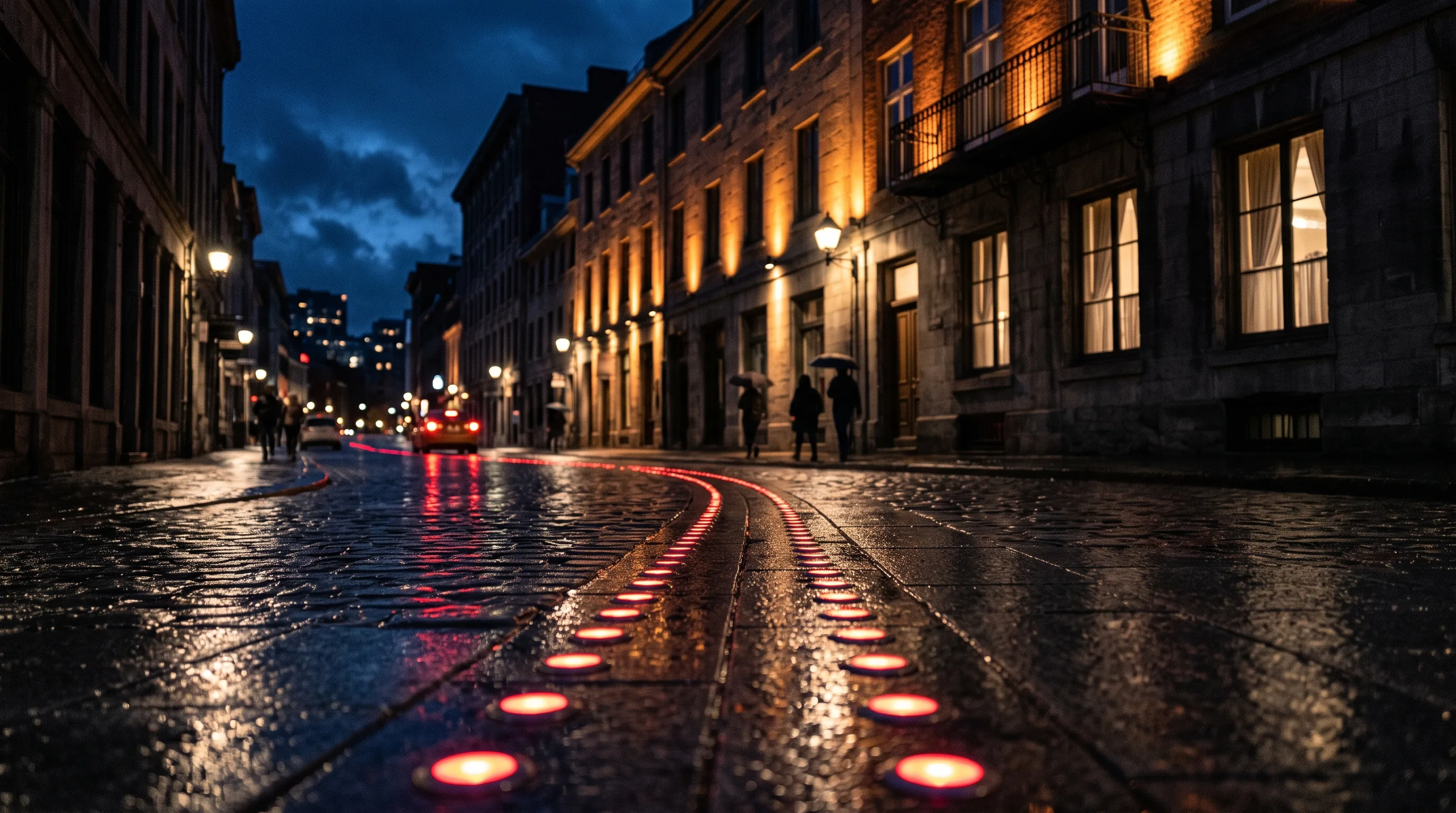
The Quartier des Spectacles is lit in red because of what the neighbourhood used to be. In 2013 the Quartier des Spectacles Partnership described its own signature lighting as “a double line of red dots that lights the sidewalk in front of the presentation venues and refers to the red carpets and to the sector’s Red Light past” (our translation). Architectural Record said it plainly in 2012: “The color is a nod to the area’s reputation as a former red-light district.”
The colour is the easy half of the answer. The decision worth stealing is where that light landed. In a 2008 interview with the urbanism magazine Spacing, Axel Morgenthaler — who designed the district’s luminous signature, those red dots projected onto the sidewalk — described looking for a single element that could tie together dozens of very different cultural institutions. He didn’t find it on the walls. He found it on the ground. And that one decision, made for a square kilometre of downtown Montréal, says a lot about how to light a house properly.
”Light is always in need of a canvas”
That’s the sentence the whole project rests on. “That’s when I noticed that the sidewalks were a blank canvas,” Morgenthaler told Spacing. “Canvas is a word I use a lot because light is always in need of a canvas — the rays go through space, but you don’t see them until they hit a surface.”
It sounds obvious. It isn’t. Most bad exterior lighting comes from exactly this misunderstanding: people buy floodlights thinking they’re buying light, when all anyone ever buys is lit surfaces. A beam thrown at the sky is invisible — it’s simply wasted. Light landing on stone, on a soffit, on a tree trunk, is the only light anyone sees.
That’s the geometric reason a permanent rail mounts under the soffit and aims downward. The facade becomes the canvas. Anything that doesn’t land on your house isn’t working for you — it’s lighting your neighbour’s yard or disappearing upward.
The lowest common denominator
The district holds buildings with little in common. By the Partnership’s own account, the area first prospered in the 1920s and 1930s on its theatres, cinemas and cabarets, then was modernized from the 1960s during the Quiet Revolution with institutions like Place des Arts and UQAM. The instinct would be to light each of them brighter than the last. Morgenthaler did the opposite.
“I didn’t want to put any more competing visual signs on the façades because there’s so many already,” he said. “I wanted something for pedestrians that identifies culture in that area.”
The plan he describes runs on three programs, which he calls resolutions of light: the signature lighting, the dynamic illumination of the facades, and electronic marquees. The hierarchy is explicit: “The lowest resolution is the common denominator, which is the signature lighting, the floor dots that are red and monochrome.”
In other words, the simplest, smallest, least spectacular element is the one that goes everywhere. The rich effects — colour, animation, storytelling — are the exception, reserved for a few facades.
Unify without flattening
The other half of the idea matters just as much, and it’s the half homeowners miss most often.
“I think it’s important that each cultural institution keeps or displays its own identity,” Morgenthaler said. “The idea is not to blend everything into one mash and say, ‘This is Quartier des spectacles.’ The important thing is to have one common denominator but to ensure that each cultural institution has its own identity and its own character.”
One element repeated everywhere, and complete freedom for everything else. He notes that the signature “can be adapted into all kinds of situations, whether it’s an older or more modern building” — restrained enough that it never fights the architecture it runs past.
When he moves up to the second resolution, he tells a story with it. At the Théâtre du Nouveau Monde, he said, “I used light to reveal the old main entrance on St. Urbain, which was the main entrance in its time before the renovation. I tried to tell an architectural story.”
Translating this to a house
A house is a district in miniature: a set of surfaces with nothing much in common. A roofline, gables, columns, an entrance, trees, a pool. The same trap applies — light each element separately, each on its own logic, and end up with a facade that looks like six decisions instead of one.
The Quartier des Spectacles method transfers directly:
- Your common denominator is the roofline. One continuous rail, in warm white, on every night. It’s what creates the coherence, and it’s the part of the system you’re actually looking at most of the time.
- The higher resolutions are exceptions. Colour, animated scenes, accented gables, ground-level landscape lighting: these are the district’s feature facades. They land because they’re rare.
- One controller decides. What holds the district together isn’t a brightness level, it’s a program. On a house, the controller and its schedule decide what comes on, when, and how bright — not whatever you feel like on a given evening.
That’s exactly the logic behind a permanent exterior lighting system: one quiet, constant line, with colour available for when it’s worth something.
The district today
The Quartier des Spectacles Partnership, created in 2003, describes its territory as home to “the greatest concentration and diversity of cultural venues in North America” — eight public spaces, 80 venues and 50 festivals a year, in a single square kilometre of downtown. The district, it says, “owes its name to the 30 venues that make it up.”
The highest resolution of light has grown considerably since that 2008 interview. The Partnership now counts four video projection surfaces where “iconic building facades come to life with original, ad-free artistic content, 365 nights a year” — and in winter, the Esplanade Tranquille skating rink becomes a fifth surface, projected onto the ice. Place des Festivals itself received the Royal Architectural Institute of Canada’s Governor General’s Medal in Architecture.
The district sits largely on what the Partnership calls the former “Red Light District,” a name dating back to the 1920s and 1930s — and that, together with the red carpet rolled out in front of a venue, is what the colour refers to. Morgenthaler doesn’t go into that history in the Spacing interview. What he explains there is the method: monochrome, on the ground, at pedestrian height, repeatable everywhere.
If you want to see what your own common denominator would be — where the line runs, in which white, and what deserves to be the exception — we’ll come to you for a free design and quote, anywhere in our service area.
Common questions
Who designed the red dots in the Quartier des Spectacles? Lighting designer Axel Morgenthaler. According to a clarification published by Spacing, he designed the district’s signature lighting — the red dots — as well as the dynamic facade illumination of the Théâtre du Nouveau Monde, the National Film Board and La Vitrine culturelle.
Why is the light on the ground instead of on the buildings? Because the facades were already saturated with signage. Morgenthaler described looking for “something for pedestrians” rather than one more signal on the walls, and seeing the sidewalks as an available “blank canvas.”
Does this principle really apply to a house? Yes, and it’s easier at a small scale. One constant element — the roofline in warm white — plays the role of the common denominator, and everything else (colour, gables, landscape) becomes the exception that lands because it’s rare.
Does a permanent residential system survive a Montréal winter? Yes. The LEDs are rated IP68 and tested to −40 °C, with a lifespan on the order of 50,000 hours and up. Controllers and pixels carry a 12-year warranty, light bars and landscape fixtures 3 years, and labour 3 years.
What does a project like this cost on a house? We price by whole project, never by the linear foot. A starter project runs around $3,000–$5,000, a standard project goes from $5,000 to $15,000, and a complete project starts around $20,000 and up — often beyond $50,000 once you combine exterior, interior and backyard.