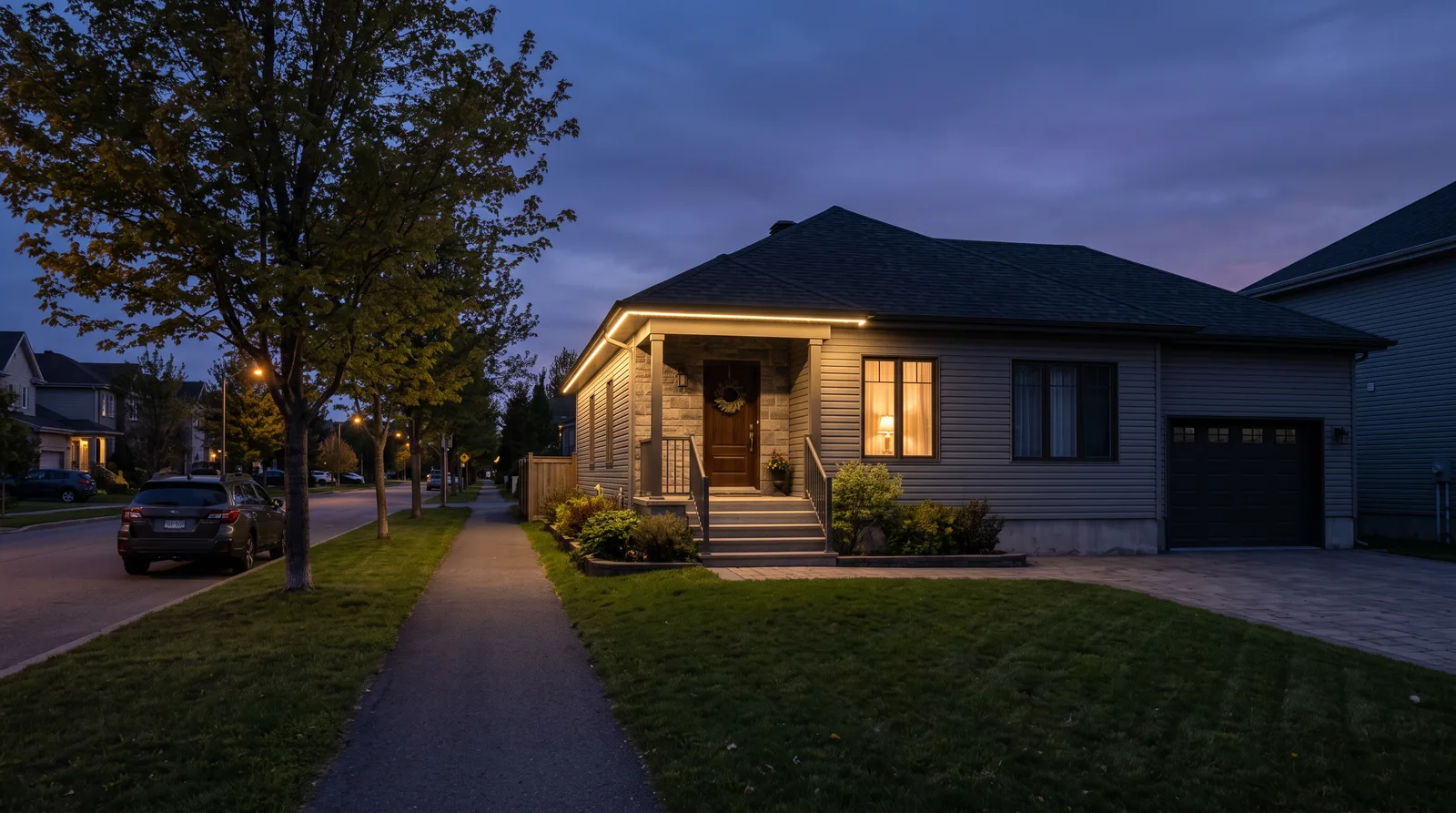
Partly, and not the way most people assume. The strongest evidence covers street lighting across a whole neighbourhood, not one house: a randomized trial in New York City public housing measured roughly 36% fewer nighttime outdoor crimes, and its authors read that as deterrence. The Campbell Collaboration systematic review on the subject — published in 2008, updated in 2022 — finds a neighbourhood explanation more plausible than surveillance. Both are arguments about neighbourhoods. Nobody has tested one house. So: lighting your facade is worth doing for several real reasons, and the security argument is the one to hold loosely.
Quick reference
- Randomized trial, New York: about 36% fewer nighttime outdoor index crimes; roughly 4% fewer index crimes overall. Its authors call deterrence the most likely mechanism.
- Systematic review: lighting reduces crime, but nighttime crime didn’t fall more than daytime crime.
- What that implies: the review’s authors find community pride and informal social control more plausible than visual deterrence. The two studies disagree, and the disagreement is worth knowing about.
- A real counter-example: in Chicago, reported offenses rose after alley lighting was improved.
- In Canada: the break-and-enter rate has fallen three years running.
What the New York trial actually measured
In 2016, a randomized controlled trial ran across New York City Housing Authority developments, with new lighting assigned at random to some sites and not others. According to the University of Chicago Crime Lab, the increased lighting produced a 36% reduction in “index crimes” occurring outdoors at night, and about a 4% reduction in index crimes overall.
Two things to hold onto. It’s one of the few randomized trials on the question, so the result carries real weight. And it tested public lighting added at the scale of an entire site, not a fixture a homeowner installs on their own house.
And one thing that cuts against the rest of this article, which you should hear from us rather than find on your own. When the trial reached the Journal of Quantitative Criminology, the authors added an analysis of arrests and concluded that deterrence is the most likely mechanism through which the lighting reduced crime. That is the strongest evidence anyone has that lighting deters. It is also evidence about lights randomly allocated to 40 public housing developments — not about one fixture on one eave.
The uncomfortable finding: the mechanism may not be surveillance
Welsh and Farrington’s Campbell Collaboration systematic review of street lighting, published in 2008, concludes that improved lighting significantly reduces crime. It also reports that nighttime crimes did not decrease more than daytime crimes, which the authors say makes an explanation based on community pride and informal social control more plausible than one based on increased surveillance and deterrence.
That isn’t an old finding left to sit. The same authors published an updated review in 2022, covering 21 studies across almost 50 years, and it lands in the same place: the reductions were larger in the studies that counted daytime crime as well as nighttime crime.
That matters, because it’s the reverse of the usual sales argument. If the effect came from a burglar seeing that he’d be seen, nighttime crime should have fallen far more than daytime crime. It didn’t.
And the case where lighting didn’t help
The 2000 final evaluation of the Chicago Alley Lighting Project reported that offenses increased in the experimental area where alley lighting was improved, over a one-year window, and over a six-month window relative to the control area. The authors, Morrow and Hutton, state that the evaluation could not definitively explain the finding.
A rise in reported offenses isn’t necessarily a rise in offenses committed — people may report more of what they can now see. Which is exactly why shortcuts in either direction deserve suspicion.
What the numbers look like here
Statistics Canada reports that the police-reported break-and-enter rate fell 11% in 2025, to 264 incidents per 100,000 population nationally. In Québec, the Crime Severity Index came in at 61.6, down 5.1%.
Those figures say nothing about your lighting. They say only that fear is a poor starting point for a design decision.
So what is facade lighting actually good for?
Seeing where your foot lands on an icy January staircase. Recognizing who’s at the door. Not being the black gap between two streetlights at 5 p.m. in November. Those are real benefits, visible to the eye, and they don’t need a crime statistic to justify them.
A permanent system also fixes something motion floodlights don’t: the light is constant, aimed downward, and it doesn’t fire into the neighbour’s window every time a cat crosses the driveway. The exterior lighting page shows how the rail sits under the soffit, and landscape lighting covers the walkway and the driveway approach.
Where to put the money if security is your only goal
Somewhere else. We’d put the money into a good lock, a reinforced door, a well-placed camera and a neighbour who picks up your mail before we’d put it into a line of light along your eave.
We’d rather say it plainly: buy permanent lighting because the house looks and works better lit, 365 evenings a year. Buying it as a security system means betting on something nobody has tested at the scale of a single house.
Common questions
Does leaving lights on all night deter a burglar? The available research can’t confirm that for a single house. Every measured effect comes from public lighting at neighbourhood scale, and the researchers disagree about the mechanism: the New York trial’s authors point to deterrence, the systematic review’s authors to a neighbourhood effect.
Is a motion sensor better than constant light? None of the studies cited here compare the two. What we see on site is that a badly aimed motion light floods the neighbour’s window and usually ends up unplugged.
Will it lower my insurance premium? That depends entirely on your insurer, and we have no source to claim otherwise. Ask your broker directly.
Why didn’t nighttime crime fall more than daytime crime? That’s the key observation in the systematic review, and the authors point to a neighbourhood effect rather than nighttime visibility.
Is my town served? The full municipality list is on the service area page, and product definitions are in the FAQ.