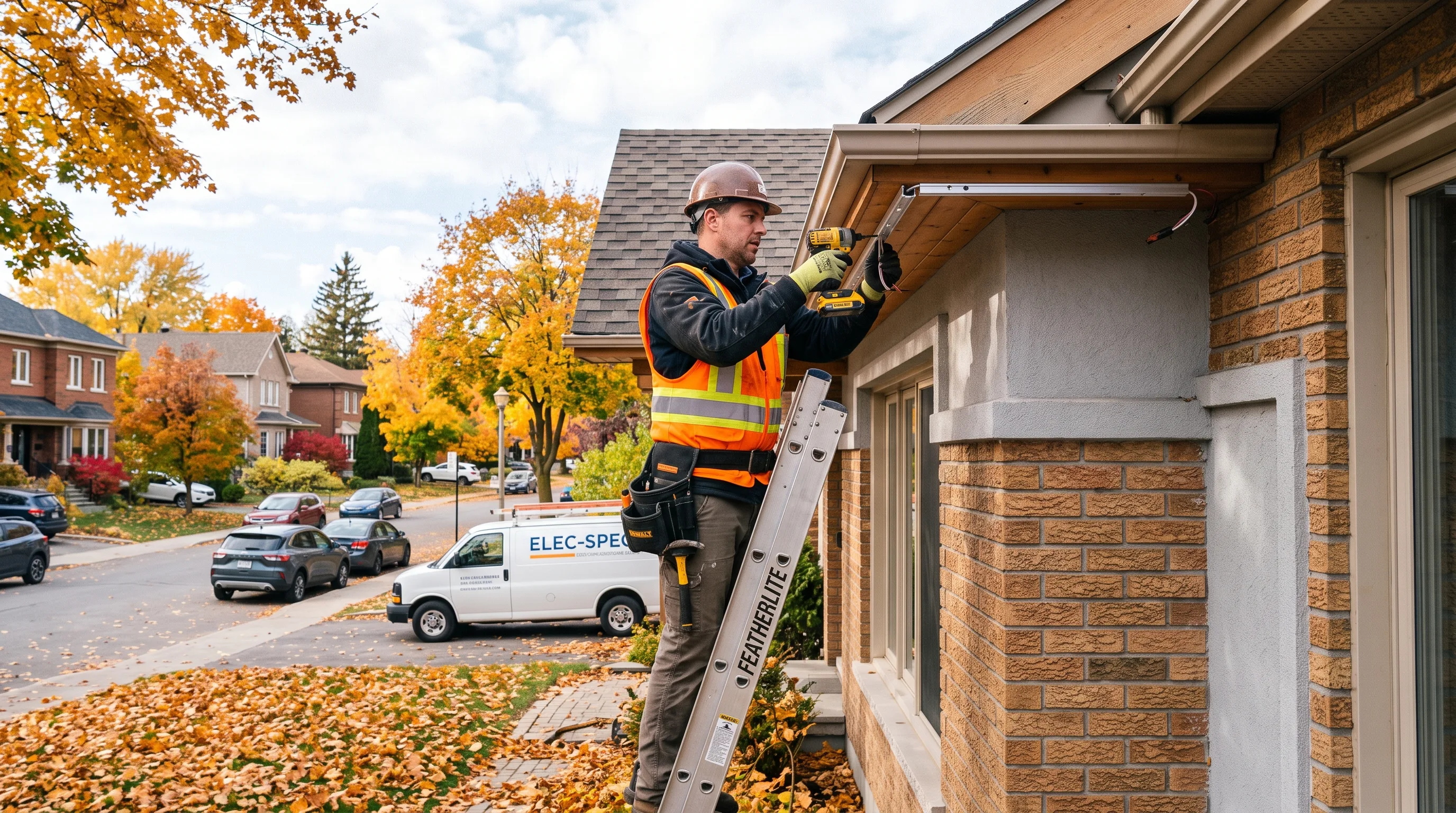
Install before the snow settles, because in Montréal that window is short. At Montréal-Trudeau, Environment and Climate Change Canada’s 1991–2020 climate normals put snowfall at 1.1 cm in October, 16.3 cm in November and 48.2 cm in December. October is the last month where snow barely counts, and the last one where putting a line along a roofline is ordinary work.
Quick reference
- Montréal-Trudeau snowfall normals: 1.1 cm in October, 16.3 cm in November, 48.2 cm in December — 216.6 cm across the year.
- November daily average temperature: 2.3 °C.
- 45% of Canadians decorate the outside of their home, against 79% who decorate the inside.
- Of Canadians who decorate, 72% start in late November or early December, which is after the turn.
- The on-site visit is free and takes about 40 minutes.
How much snow falls before December?
Almost none in October, and then it turns over at once. ECCC’s normals put November at 16.3 cm against October’s 1.1 cm — close to fifteen times the snow from one month to the next. November’s daily average temperature is 2.3 °C, barely above freezing for the whole month.
December adds 48.2 cm on top of that. And that is exactly when most people get started: an online survey run 12–14 November 2025 by Narrative Research and the Logit Group among 1,231 Canadians aged 18 and over asked those who decorate when they start: 17% say early November, 35% late November, 37% early December and 11% mid-to-late December. Which means 72% begin after the November jump, once the month’s normal snowfall has gone from 1.1 cm to 16.3 cm. The same survey reports 79% decorate the inside of their homes and 45% the outside — and the outside half is the half done on a ladder.
Those are Canadian figures rather than Québec ones, and an online panel is not a census. But the shape of the calendar is clear: 83% of the people who decorate start in late November or later.
What snow changes on a facade
A second-storey soffit is straightforward from a stable ladder on dry ground. The same footing on a glazed driveway is a different job entirely.
Peaks make the point clearest. They are the highest, least reachable parts of the house, and they are exactly what draws the building’s shape after dark. During the visit we walk the property with you, talk through what you want lit every night, show you a demo, go through the whole-project quote line by line, then measure: rooflines, levels, soffits. A boxed soffit and an open eave do not take the same rail, and that is the kind of detail that gets settled on site.
The visit photos also feed the 3D mockup of your own house. They read better before snow covers the trim lines and the soffit colour. The visit, the measurements, the photos and the mockup cost nothing.
What you stop doing in December
This is the real argument, and it has nothing to do with light: the rail goes up once. Someone climbs in the autumn you install it, and after that nobody climbs again. Holiday lighting stops being a day of work in the cold.
The rest of the year the same line draws the architecture of the house instead of sitting in a box in the basement. The exterior lighting page shows what that looks like zone by zone.
What it does not solve
Permanent lighting draws the architecture. It does not decorate your yard. If your December depends on an outdoor tree, inflatables and garlands in the hedges, you will still be outside in the cold — the rail lights the building, not the lot.
The warranty is worth reading before you assume one number covers everything, because it splits by part: three years on light bars and landscape fixtures, twelve years on controllers and pixels. Labour is a separate warranty at three years.
For the ground itself, that is a different system — landscape lighting lives in the beds and the trees rather than under the soffit.
Common questions
Is it too late once the snow has arrived? That is a job-by-job answer. Timing depends on the site and the season — call us at (450) 999-7258 and we will tell you where the calendar stands.
What happens during the visit? About 40 minutes, free. We walk the property with you, talk through what you want lit, show you a demo, present the whole-project quote line by line, then measure. It is also where the real scope for your house gets settled.
Does the system handle a Quebec winter? The LEDs are IP68 rated and tested to −40 °C, with a rated life of 50,000 hours and more — roughly 15 to 23 years of normal use.
What does the warranty cover? Twelve years on controllers and pixels, three years on light bars and landscape fixtures, and three years on labour. There are more answers of this kind on the FAQ page.
Is my town covered? We cover a wide part of Greater Montréal and several regions around it. The full list is on the service area page.