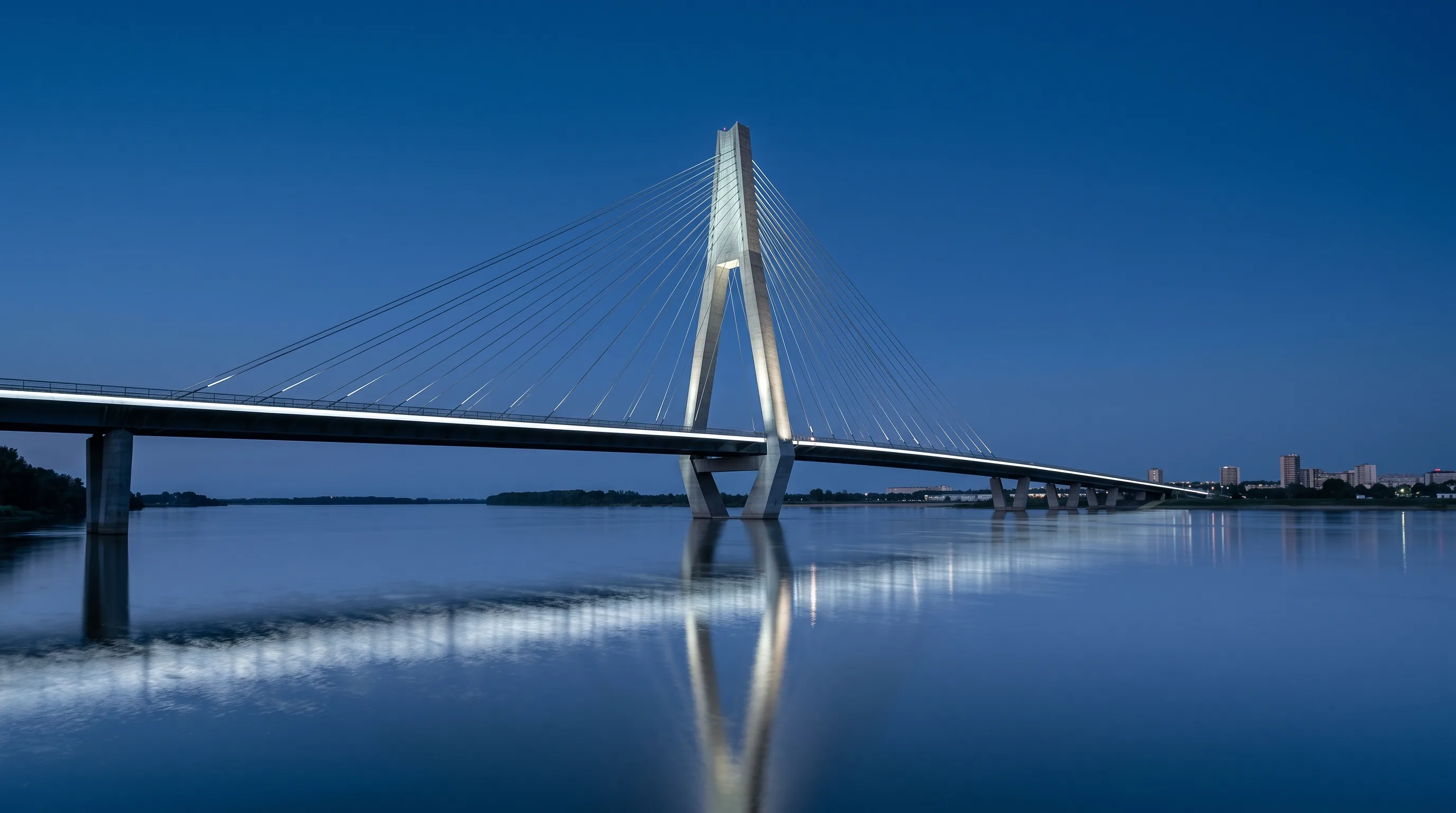
During two dated windows each year, the Samuel De Champlain Bridge’s preset colours turn blue and green — and that is not a theme night, it is a wildlife measure. The bridge’s official site puts it plainly: “Apart from special illuminations, the preset colors will be green and blue to avoid disturbing the flight pattern of birds.” Those windows run “from March 1 to June 15 and from August 1 to November 20”, because “these colours are less attractive to birds, helping to reduce the risk of collision with bridge structures.” On this bridge, colour is not a costume. It is a constraint.
That is what makes the bridge worth reading if you are thinking about lighting your own house. The three decisions that matter are visible from the shoreline — when the light is on, what colour it is, and how bright it runs — and all three lean toward restraint.
Colour answers to a calendar, not to a mood
The two migration windows are dated, published, and between them they cover a large part of the year. The colours that apply inside them were not a designer’s preference: they were “chosen following consultations with Environment and Climate Change Canada and Quebec’s Ministère des Forêts, de la Faune et des Parcs.”
Note what the source actually says: less attractive, not harmless. It is a risk reduction, not a solution. That precision is itself a lighting lesson — good exterior-light decisions are almost always mitigations, never clean wins.
The white setting is capped, and it is the default
The rest of the year, white is the default — and not white at full power: white lighting is “the default illumination, with intensity carefully controlled to minimise impacts on maritime traffic or communities around the bridge.” That setting was developed “in consultation with the project’s Visual Quality Advisory Committee, Environment and Climate Change Canada and the St. Lawrence Seaway Management Corporation.”
In other words, on a structure at that scale the question was never “how much light can we put on it” but “how much can we take away without losing the effect.” That is exactly the question to ask in front of a house, where the neighbour across the street plays the part of maritime traffic.
Switching off at 1 a.m. is part of the design
The bridge “comes alive every evening, illuminated from sunset to 1:00 a.m.” The published exception to the 1 a.m. cut-off is New Year’s Eve, when the lighting runs later, to 4 a.m. The calendar also runs one the other way: on Earth Hour, “(8:30 p.m. to 9:30 p.m.) No illumination”.
So a lighting design HLB spent “over five years meticulously developing”, and which the Signature on the Saint Lawrence Group programs under the direction of Housing, Infrastructure and Communities Canada “based on various operational, social, and environmental criteria”, still stops at 1 a.m. The shut-off time is not a budget compromise bolted on afterwards — it is a feature of the system, decided alongside everything else.
What scale does not change
The bridge’s system carries “over 7,500 light-emitting diode (LED) bulbs”, and the light “carries the dynamic movement of light along the entire length and up the inner faces of the cable stay tower” — a design by HLB, which lists T.Y. Lin International and Donald MacDonald Architects on the design team and an Illuminating Engineering Society Award of Merit among the project’s awards.
Your house does not have a cable-stay tower. But the three levers are identical, and they get set on installation day:
- The schedule. A shut-off time decided in advance beats a switch nobody remembers. It is the easiest setting to skip and the one that most changes how your neighbours read the installation.
- The colour. Warm white as the permanent state, colour as a rare and motivated exception — we make the case for it in warm white vs colour. The Jacques Cartier bridge changes colour on a 365-colour seasonal calendar, this one on a migration calendar — different reasons, the same refusal to improvise. A facade that changes colour for no reason reads as decoration rather than architecture.
- The intensity. A system capped at the right level is the one you notice without looking at it. Too strong and the house turns into signage.
On a permanent exterior lighting project, those three settings are what the on-site visit is for — about 40 minutes, free: we walk the property with you, talk through what you actually want lit every night, show you a demo, walk the whole-project quote line by line, then measure the rooflines, levels and soffits.
The hardware side is a question of duration in the same way: the LEDs are rated IP68 and tested to −40 °C, and the warranty runs 12 years on controllers and pixels and 3 years on light bars and landscape fixtures, with 3 years of labour. A system you program for a decade has to survive ten winters first. If you want to see what that looks like outside of a rendering, our projects are the place to start.
Common questions
Is the Samuel De Champlain Bridge lit all night? No. The architectural lighting runs from sunset to 1 a.m. New Year’s Eve runs later, to 4 a.m., and Earth Hour goes the other way — the calendar lists “No illumination” for that hour.
Why blue and green during migration rather than another colour? According to the bridge’s official site, those colours are less attractive to birds and help reduce the risk of collision with the bridge structures. They were chosen after consultations with Environment and Climate Change Canada and Quebec’s Ministère des Forêts, de la Faune et des Parcs.
Does residential lighting create the same problem? At a completely different scale. But the same settings — aiming light at the building, capping intensity, planning a shut-off time — are what separate an installation people notice from one that bothers them.
Can a shut-off time be programmed on a permanent system? Yes, it is a controller setting like any scene. It is one of the things worth deciding during the visit rather than after.